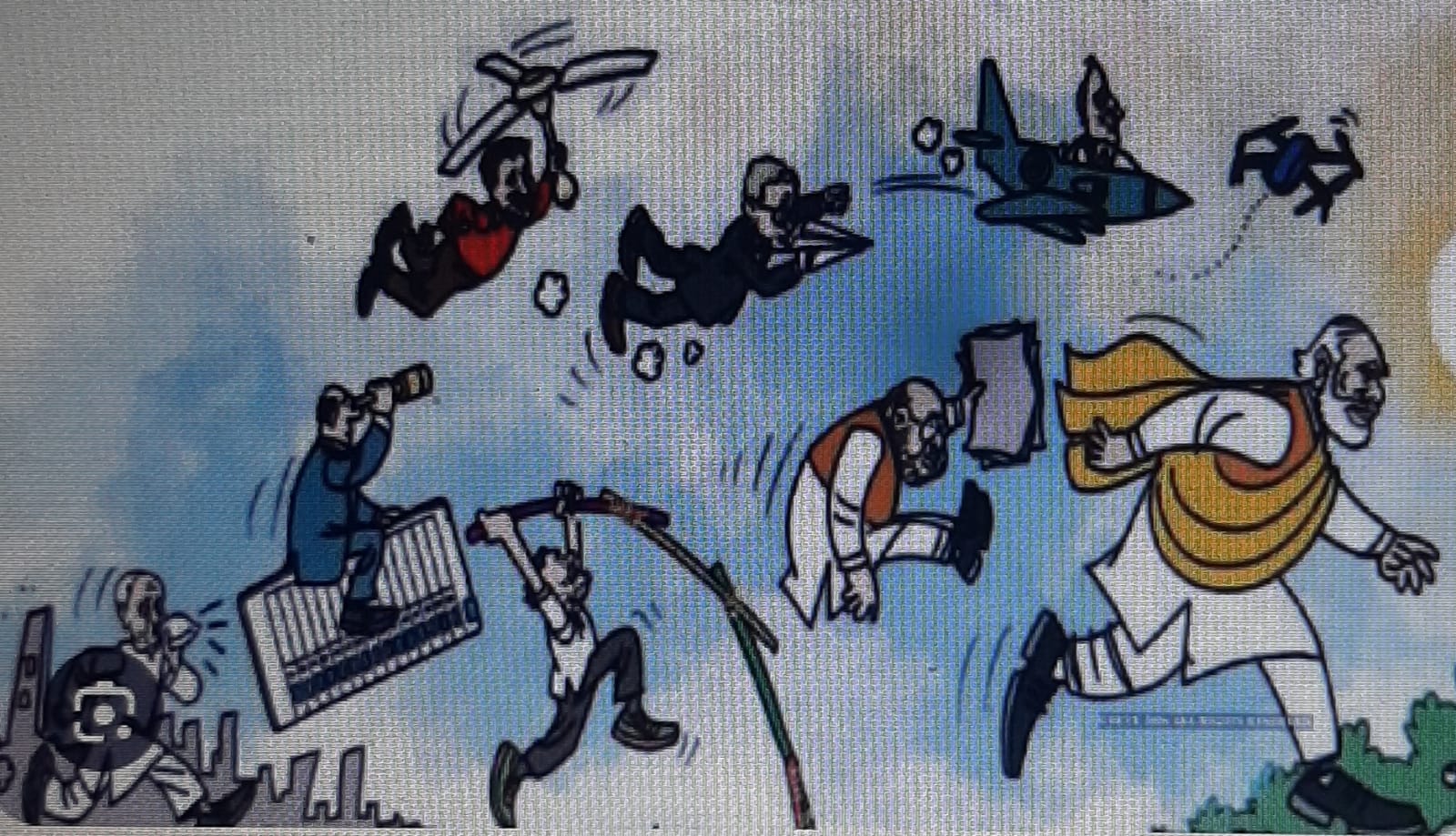



There is hardly any mention of the governance structure that would be in place for bringing about this radical transformation in just over two decades. It seems the existing administrative structure aided by digital tools is expected to deliver even when there is hardly any evidence to support this optimism given the crumbling cities, mountain-heaps of garbage, overflowing drains and unbridled corruption with which citizens have to come to terms everyday, writes former IAS officer Sunil Kumar
The term ‘Viksit Bharat’ would have entered the law books by the time this article gets published. It finds mention in the title of the Bill No.197 of 2025 introduced in the Lok Sabha on 16th December, 2025 – The Viksit Bharat – Guarantee for Rozgar and Ajjevika Mission (Gramin) – VB-G RAM G Bill, 2025. The Prime Minister had declared from the ramparts of the Red Fort[i] that India would become a developed country by the year 2047 and, since then, this is the vision or dream that is being publicized by the Government. Some economists have joined the bandwagon and are claiming that India would be a 30 trillion USD economy by 2047 when the current 25-year phase (Amrit kaal) would officially come to an end.
The term finds mention in the statement of reasons for introducing the VB -G RAM G Bill, 2025 and in Section 1(1) giving the short title of the Bill. In Sec.2 (v) and (w) the terms “Viksit Bharat National Rural Infrastructure Stack” and “Viksit Gram Panchayat Plan” have been defined. The latter is supposed to mean a future-ready, convergence-based local development plan aligned with the vision of Viksit Bharat@2047…..In Sec.4(2) it is stated that Viksit Bharat National Rural Infrastructure Stack shall encompass four thematic focus domains, namely water security through water-related works; core rural infrastructure; livelihood-related infrastructure; and works for the mitigation of extreme weather events. The scheme prepared by the State government is to conform to the minimum features laid down in Schedule 1 as mentioned in Sec.8(3) of the Act.
A Working paper authored by Arvind Virmani, a member of NITI Aayog, captioned “Vision for Viksit Bharat @ 2047: An Approach Paper” comes closest to an enunciation of the national vision. However, it has been clearly mentioned that this Working paper is based on the policy paper, “India Vision 2050,” PP No-01/2021, EGROW Foundation, May 2021 and the views expressed in the paper are those of the author and should not be attributed to NITI Aayog or the GOI. Given this rider, it can be safely concluded that there is no official version of the National Vision of Viksit Bharat@2047. However, that does not dissuade the senior government functionaries and party functionaries of the ruling National Democratic Alliance (NDA) from referring to the ‘Amrit Kaal’ and India becoming a developed country come 2047!
The dream that is being sold is that 1.6 billion Indians would leap-frog from their current stage of a ‘low middle-income country’ to a ‘high-income country’ by the year 2047. This would largely be facilitated by the use of latest digital technology and tools. AI driven expert systems like E-Kautilya, E-Chanakya, E-Manu are expected to drive a transformation in governance and expert systems like E-Acharya, E-Guru and E-Vaid will drive the transformation in education, skilling, and health services. Obviously, poverty would become a ‘distant memory’ and world-class cities, towns and villages with world-class infrastructure would be there for the world to see. The largest network of expressways, gleaming airports, heli-ports and railways stations, bustling sea-ports, glass-clad multi-storey buildings, multi-speciality hospital chains catering to the rich and shining, sprawling private universities dotting the landscape would complete the picture of ‘Viksit Bharat’. To this would be added India’s military might and a bustling defence-industrial complex which helps project India’s power. In all probability, India would also, by then, be a permanent member of the UN Security Council armed with the coveted ‘veto’ power.
There is hardly any mention of the governance structure that would be in place for bringing about this radical transformation in just over two decades. It seems the existing administrative structure aided by digital tools is expected to deliver even when there is hardly any evidence to support this optimism given the crumbling cities, mountain-heaps of garbage, overflowing drains and unbridled corruption with which citizens have to come to terms everyday.
In this article, the focus is on what the rural areas of the country would look like especially as Viksit Gram Panchayats are now formally and legally recognized as the building blocks of Viksit Bharat in the VB-G RAM G Act, 2025.
However, there is no definition of a ‘Viksit Gram Panchayat’ in the new Act. What it means has been left unsaid. Does it mean every family would have a decent house with proper ventilation and lighting to ensure a decent standard of life? Would the streets be wide-enough to allow fire brigade vehicles to enter and engage in fire-fighting operations should the need arise? Would underground sewerage and drainage systems be the norm in all villages? Would re-development of villages be undertaken to ensure that all civil constructions in the village conform to building norms and are ‘earthquake resistant’? Would villages located in the flood plains be re-located on higher grounds? Would all villages have play-grounds, parks and open spaces for recreation? Would residents of rural areas have access to the same standard of services (electricity, water supply, sewerage etc.) as are available in the urban areas? These are just some of the questions that spring to mind.
A perusal of the indicative items of work related to all the four domains listed in Schedule 1 (mentioned in Sec.8(3)) does not reflect anything ‘extraordinary’. It is more of the same. A new GP building will come up in one corner; a school in the other; and a warehouse in another. There is no mention of a Master Plan of any GP being prepared which, after approval by the Gram Sabha, would form the basis of Viksit Gram Panchayat Plan (VGPP). So VGPP is likely to remain an amalgamation of individual works prepared annually with little or no connection to either the current demand or future aspirations of the residents. The selection would be based on current availability of funds and what possibly fits into the priorities determined by officials of various departments at the district and state level if not union level.
What would happen in practice is that GP wise allocations would be made at the State level by the Rural Development department and communicated to the districts and the GPs and works would be undertaken accordingly. As part of the convergence model, different departments would compete to get the labour component of their works included under the Viksit Gram Panchayat Plan (VGPP). The needs of the people and their demands would take a back seat. The participatory, people-led preparation of Gram Panchayat Development Plan (GPDP) (which was just about stabilizing after a decade’s efforts) has been given a quiet burial.
A viksit Gram Panchayat is not just scattered public buildings or solar street lamps and roof-top solar installations. It is not public libraries or provision of digital services either. It should cover the social and economic structure and address the issue of governance deficit. The Act does not address the major issues relating to governance structure at the district, block and panchayat level. The role of local government is restricted to affixing it’s stamp of approval on schemes prepared and consolidated by officials at the GP/Block/District level.
The structural deficiencies plaguing the MGNREGA have not been addressed in the new Act. The top-down approach remains very much in evidence with demand likely to be tailored to meet the allocation made by the union government. Faith continues to be reposed in the District Collector and the BDO who continue to be the District Programme Coordinator and the Programme Officer under the new Act. The role of the rural local governments at Block and District level continue to be peripheral. Gram Panchayat is seen more as an implementing agency than as an autonomous body authorised to take decisions regarding implementation of the programme. The responsibility of providing 125 days of work per annum per eligible household is entirely of the state government. The purse strings are controlled by the union government. By introducing the concepts of VGPP as part of the Viksit Bharat National Rural Infrastructure Stack (VBNRIS), the tendency to centralize power has been given added impetus. The guarantee cannot be enforced and there is nothing to suggest that payment of unemployment allowance would become a reality under the new Act.
In effect, what is being sold to the citizens is a new dream built around the undefined concept of Viksit Bharat and Viksit Gram Panchayat. Political parties would reap the dividends depending on how well they are able to ‘market’ and ‘sell’ this dream in the years to come. As far as citizens are concerned, guarantees will remain ‘unenforceable’ and they would be left competing for whatever ‘left overs’ they can lay their hands on. The hope that through digital technology the issue of corruption can be tackled will remain unrealized. Union government will launch a publicity blitz to take all credit, state governments will be left to take all the blame and local governments will keep wondering what is their role even as the bureaucracy would make merry.
(Sunil Kumar is a visiting Fellow associated with Centre for Co-operative Federalism & Multi-level Governance in Pune International Centre and a former civil servant. Views expressed are personal.)
[i] Prime Minister’s 76th Independence Day Address on 15th August, 2022