

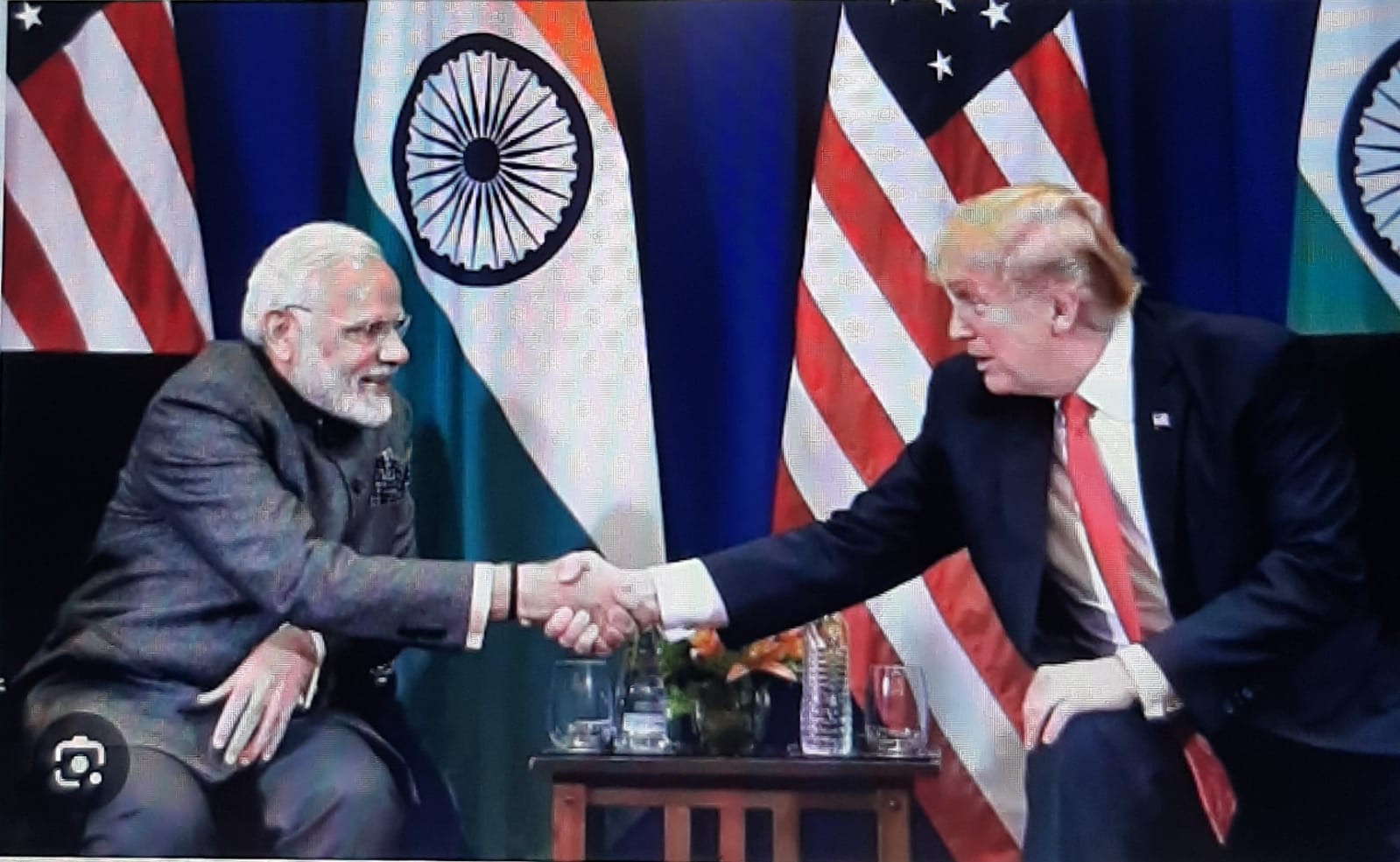
The US-India trade deal is not a full-fledged Free Trade Agreement (FTA). It is an interim framework that lowers tariffs selectively, signals regulatory cooperation, and sets a direction for future negotiations. There are no enforceable commitments on labour mobility, visa liberalisation, or guaranteed market access — areas where India traditionally seeks reciprocity, writes former IAS officer V.S.Pandey
There is big debate raging- in Parliament, press, electronic media, corporate board rooms and amongst ideologues. opinion is obviously divided as everyone examines the issue from his own perspective and self-interest. The farmers lobby is up in arms, the pharma industry is jubilant. The sentiments are naturally aligned to their own interests, whether served or undermined. So confusion reigns across various sectors of our economic landscape.
The recently announced interim trade framework between India and the United States has been projected as a diplomatic breakthrough and an economic milestone, with an ambitious bilateral trade target of $500 billion by 2030. Government statement’s emphasizes strategic convergence, market access, and India’s growing global stature. Critics, however, argue that India has “bent backwards” to accommodate American demands without securing commensurate economic gains.
The truth, as is often the case in trade diplomacy, lies somewhere in between. This agreement is neither a decisive economic victory nor an outright capitulation. It is better understood as a strategic bargain with uneven economic consequences, shaped as much by geopolitics as by commerce.
To begin with, the deal is not a full-fledged Free Trade Agreement (FTA). It is an interim framework that lowers tariffs selectively, signals regulatory cooperation, and sets a direction for future negotiations. There are no enforceable commitments on labour mobility, visa liberalisation, or guaranteed market access — areas where India traditionally seeks reciprocity.
The centerpiece of the announcement — the $500 billion trade target — is aspirational, not contractual. Such targets create political optics but do not automatically translate into export growth unless backed by sectoral competitiveness and supportive domestic reforms.
India’s most consequential concessions lie in three areas. First, agriculture. While staples such as wheat, rice, and dairy remain protected, India has agreed to open space for American agricultural and processed food products. Given the heavily subsidized nature of US agriculture, even limited access creates long-term competitive pressure on Indian farmers. More importantly, it dilutes India’s long-standing principle of food sovereignty, which treats agriculture not merely as a trade sector but as a livelihood issue.
Second, the digital economy. India’s agreement to phase out its digital services tax marks a significant policy retreat. This tax was one of the few instruments available to developing economies to extract revenue from global digital monopolies that operate across borders but pay little tax locally. Its withdrawal secures short-term diplomatic calm but weakens India’s leverage over Big Tech at a time when data, platforms, and digital rents are becoming central to economic power.
Third, regulatory alignment. While often presented as “ease of doing business”- alignment with US standards effectively transfers rule-setting influence to American institutions. For large Indian firms this may be manageable; for MSMEs it raises compliance costs and entry barriers.
India did secure gains, though they are sector-specific rather than economy-wide.The pharmaceutical sector stands to benefit the most. India already dominates the US generics market, and smoother regulatory cooperation can consolidate this advantage. However, this comes with future risks, as intellectual property protections and pricing controls are likely to resurface in subsequent negotiations.
Textiles, garments, and leather may gain from tariff reductions, potentially boosting employment. Yet these gains depend heavily on India’s ability to improve logistics, scale production, and meet stringent US labour and ESG standards — challenges that lie largely within domestic policy control.
Manufacturing presents a mixed picture. The deal could help integrate Indian firms into US-centric supply chains seeking alternatives to China. But without deliberate industrial policy, India risks being locked into low-value assembly roles rather than becoming a genuine manufacturing hub.
What India notably did not gain is equally telling. There is no meaningful easing of US visa regimes for Indian professionals, no binding assurance against future protectionist tariffs, and no explicit recognition of India’s development concerns in areas such as public procurement and state support.
If judged purely on trade economics, the deal appears asymmetric. India has accepted higher imports, reduced policy space, and regulatory adjustments, while export gains remain uncertain and contingent. India already runs a trade surplus with the US, but this framework does little to guarantee its sustainability.
However, trade logic alone does not explain the agreement. The real driver is strategic alignment. The United States sees India as a critical partner in diversifying supply chains away from China and stabilising the Indo-Pacific. India, in turn, values access to the world’s largest consumer market and the geopolitical reassurance that comes with closer US ties.
In this sense, India has paid an economic price for strategic positioning.
The crucial question is not whether India conceded too much, but whether it can convert strategic proximity into economic capability. Trade agreements do not automatically create competitiveness; they expose its absence. If India uses this framework to upgrade manufacturing capabilities,
support MSMEs in meeting global standards, protect core policy space in agriculture and public health, and build domestic digital champions, then the deal may prove defensible in hindsight.
If, however, India treats this as an endpoint rather than a starting point — relying on market access without strengthening domestic capacity — the asymmetry will widen.
Certainly,India did not “bend backwards” in the sense of surrendering all its interests, but it did bend — selectively and strategically. The deal reflects a conscious choice to privilege geopolitical alignment over immediate economic symmetry. In the harsh real world , there are no free lunches. So India ceded some space to access a convenient, more cosy space with the sole world power. It’s not bad diplomacy or bad economics. Give and take has been the cornerstone of international diplomacy .
Whether the choice was wise will not be decided in Washington or New Delhi by press conferences, but in India’s factories, farms, startups, and policy institutions over the next decade.
Trade agreements, after all, do not create strength; they reveal it.
(Vijay Shankar Pandey is former Secretary Government of India)