

India’s cities face a twin planning crisis. The first is the slow creep of rigid land-use separation — the idea that residential and commercial activities must be kept strictly apart. The second, and more devastating, is our pathologically low Floor Area Ratio (FAR), which caps how much can be built on any given plot, writes former IAS officer V S Pandey
Walk through any older neighbourhood in Mumbai, Jaipur, or Lucknow and you will encounter one of the great unacknowledged successes of Indian urban life: the chai stall wedged between two apartments, the tailor operating from a converted ground floor, the chemist sharing a wall with a family home. This organic, chaotic, intensely productive mixing of living and commerce is what makes Indian streets alive. It is also, increasingly, what our planning laws are trying to stamp out — while simultaneously preventing us from building enough homes for the hundreds of millions who desperately need them.
India’s cities face a twin planning crisis. The first is the slow creep of rigid land-use separation — the idea that residential and commercial activities must be kept strictly apart. The second, and more devastating, is our pathologically low Floor Area Ratio (FAR), which caps how much can be built on any given plot. Together, these two inherited planning doctrines are producing a slow-motion catastrophe: soaring land prices, 65 million people living in slums, and cities sprawling outward into farmland because we refuse to let them grow upward.
A Doctrine Born in a Different World :The separation of residential and commercial land uses has a rational origin. When nineteenth-century European and American cities began industrialising, planners quite reasonably decided that a textile mill or a slaughterhouse should not share a street with a primary school. By the mid-twentieth century, however, this sensible idea had calcified into something far more rigid. American “Euclidean zoning” — named after a landmark 1926 Supreme Court case — mandated that residential zones contain only housing, commercial zones only shops and offices, and industrial zones only factories. The functions of daily life were deliberately separated from each other, and an entire continent was remade around the automobile to stitch them back together.
The results have been well-documented and largely negative. In the United States today, less than five percent of urban land allows any mixing of residential and commercial uses. The “zoning tax” in San Francisco — the artificial inflation of home prices caused by restrictive land-use rules — has been estimated at over $400,000 per home. Vast residential suburbs are economically dead from nine in the morning to six in the evening. Streets are unsafe because no one walks them. Small businesses starve for footfall.
What the Rest of the World Learned: The more interesting story is what enlightened cities did differently. Japan is the global benchmark. Japanese zoning follows a cumulative “cascade” system: as you move up the zone categories, more uses are permitted, but none are stripped away entirely. Even in the most restrictive residential zone in Tokyo, you can run a small café, open a neighbourhood bakery, or operate a professional office. Corner stores are embedded in housing areas by design. Home-based businesses are normal, not exceptional.
The result is the walkable, vibrant, economically productive streetscape that visitors to Tokyo find so compelling — and so different from the dead suburban sameness of American cities. Tokyo is, despite being one of the world’s largest metropolises, also one of its most affordable major cities. Japan’s liberal zoning is a significant reason why.
Germany, France, and the United Kingdom have each moved decisively toward mixed-use models. Germany in 2017 created an entirely new zoning category — “Urbane Gebiete” — specifically to allow residential and commercial uses to coexist in dense urban areas. Paris now mandates that large office developments incorporate residential units. Vietnam, with its centuries-old tradition of the shophouse — commercial on the ground floor, family living above — has embedded mixed use into its urban DNA and is actively protecting it from the homogenising influence of planned new townships.
The United States, the pioneer of destructive single-use zoning, is now frantically unwinding what it built. Minneapolis has eliminated single-family-only zoning citywide. Portland, Sacramento, and Richmond are following. The direction of travel globally is unmistakable: mixed use is the future of liveable cities.
India’s FAR Trap: If the mixed-use question in India is complex — our older cities are already organically mixed, and enforcement of separation is largely discretionary — our Floor Area Ratio crisis is straightforward and severe.
FAR determines how much total floor space can be built on a given plot. An FAR of 2.0 on a 1,000 square-foot plot permits 2,000 square feet of construction, spread across as many floors as the builder chooses within that envelope. It is the single most powerful lever in urban planning: raise it, and you increase housing and commercial supply; cap it, and you create artificial scarcity.
India’s FAR caps are, by any global standard, grotesquely low. Mumbai’s base FSI (the local term for FAR) was 1.33 for decades — one of the lowest of any major city in the world. Bengaluru allows 1.75 FAR on smaller roads. Chennai hovers around 1.5 to 2.5. Delhi is marginally better. Compare these to the cities India aspires to rival: New York City permits FAR up to 15 in commercial zones. Tokyo allows 10 in its central business district, with the highest commercial plots reaching an FAR of 13. Even Paris, a city famous for protecting its low-rise character, operates at 3 to 4.5. Singapore deploys FAR between 4 and 14.
The planning logic behind India’s low FAR is antique. When Nehru-era planners adopted the British colonial planning framework and layered onto it the modernist ideas of Le Corbusier, they believed that capping building density would prevent urban overcrowding. The reasoning was intuitive but catastrophically flawed. Capping FAR does not reduce the number of people who want to live in a city. It simply ensures that formal, legal, serviced housing cannot keep pace with demand. The population density arrives anyway — but in slums, illegal floor additions, and informal settlements rather than in properly planned, structurally sound buildings.
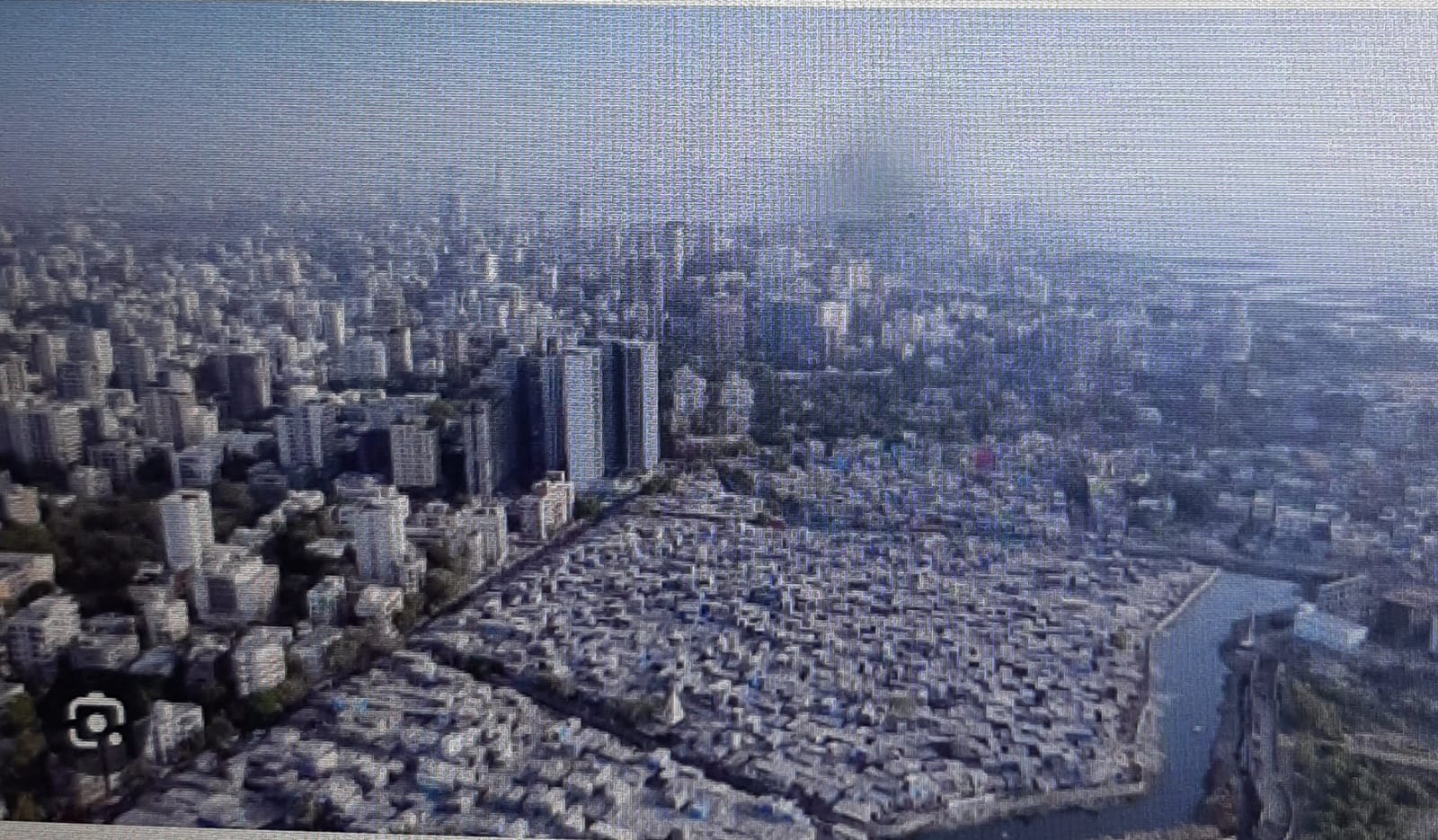
Dharavi, often described as Asia’s largest slum, sits in the heart of one of the world’s most expensive real estate markets. This is not a paradox — it is a direct consequence of a planning system that has, for six decades, prevented Mumbai from building enough homes. Restrictions on FAR create artificial scarcity of buildable space, which drives up land prices beyond what working-class families can afford, which pushes them into informal settlements, which then require expensive slum-rehabilitation schemes that deliver inadequate housing in poor locations. The policy that was meant to prevent overcrowding has manufactured some of the most overcrowded conditions in human history.
The Political Economy of Scarcity: Why does this continue? Low FAR serves powerful interests. When buildable area is capped, land becomes extraordinarily scarce relative to demand, and its price rises accordingly. Those who already own prime urban land benefit enormously from this scarcity. A handful of large landholding families and institutions — among them government bodies like the railways and port trusts sitting on enormous swathes of city-centre land — have every incentive to preserve a planning regime that makes their assets more valuable. The political economy of urban land in India is, at its core, a story of manufactured scarcity protecting inherited wealth.
The Infrastructure Objection and Its Answer: Defenders of low FAR argue that India’s urban infrastructure cannot support higher density: the water supply is strained, the roads are congested, the sewage systems are overwhelmed. This is a genuine concern. But it is an argument for planned, phased densification with infrastructure investment — not for permanent caps.
The answer is transit-oriented development. Raise FAR substantially — to 5, 8, even 10 — in corridors around metro and suburban rail stations. Use the development charges generated by the resulting construction boom to fund the infrastructure those buildings require. Plan the density increase with adequate lead time. Delhi’s Master Plan 2041 gestures in this direction. Mumbai, after decades of pressure from economists and urban planners, raised its FSI to 3 for residential and 5 for commercial areas in 2018. These are improvements, but they remain timid relative to what India’s cities actually need.
A Choice About the Future: India will add nearly 400 million urban residents by 2050. Its cities cannot sprawl endlessly — agricultural land, aquifers, and commuting hours are already at breaking point. The only sustainable path is upward. Tokyo built a globally admired urban civilisation by allowing its cities to grow tall, mixed, and dense. Singapore did the same. Both have world-class public transport, affordable housing relative to incomes, and streets that are economically alive at every hour.
India has the same choice to make. It requires overriding entrenched interests, updating planning laws conceived for a smaller and poorer country, and accepting that the modernist dream of separating urban functions into tidy zones was always, at its heart, a fantasy. Our cities were mixed long before planners arrived. It is time to let them be mixed again — and tall enough to actually house the nation.
(Vijay Shankar Pandey is former Secretary Government of India)