

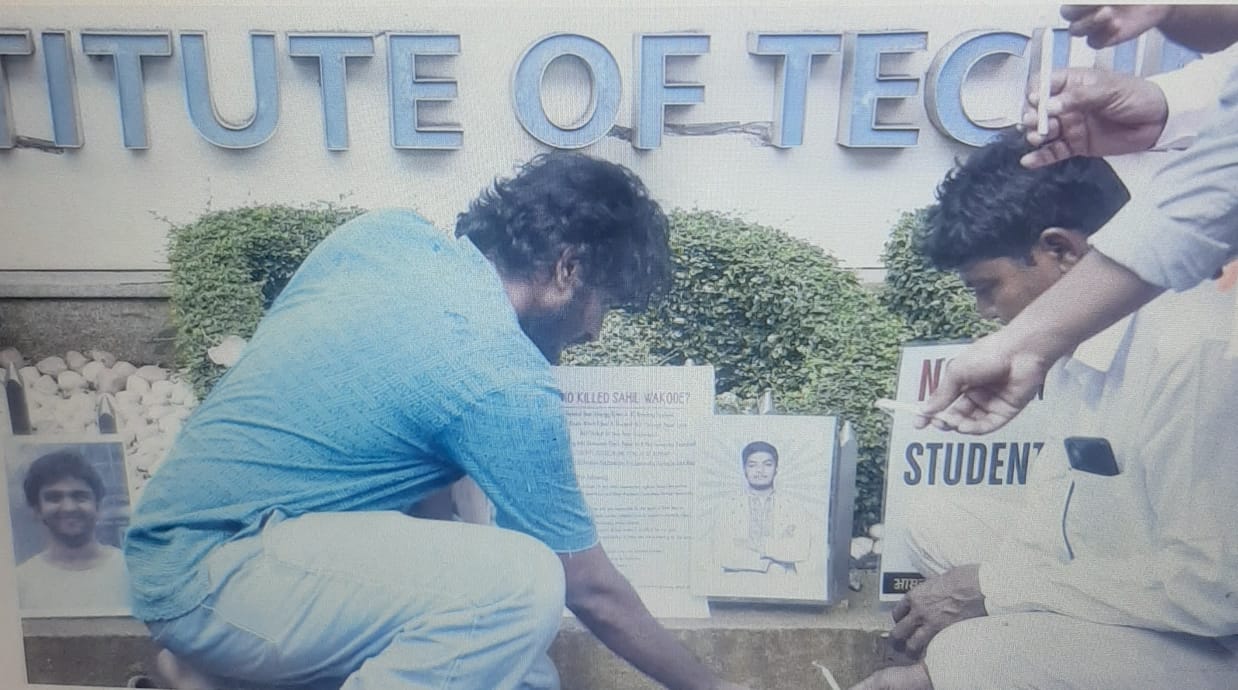
What should have remained a routine exam-integrity matter has since spiraled into one of the most polarizing controversies to hit the Powai campus, drawing in students, faculty, the police and, increasingly, national opinion on both sides of India’s caste discourse, writes former IAS officer V.S.Pandey
A campus that has seen this grief before is once again caught between grief, suspicion and due process, three days after a second-year B.Tech student at IIT Bombay died by suicide in his hostel room following a cheating allegation during a mid-semester examination.
Sahil Wakode, a student in the Department of Energy Science and Engineering, was found using a mobile phone during an exam on September 18. The institute said he had uploaded the question paper to an AI chatbot to seek answers, and that he was counselled by his instructor and department head, with no disciplinary action initiated against him. Hours later, he was dead.
What should have remained a routine exam-integrity matter has since spiraled into one of the most polarizing controversies to hit the Powai campus, drawing in students, faculty, the police and, increasingly, national opinion on both sides of India’s caste discourse.
Wakode’s parents allege their son faced months of caste-based harassment, and have filed a police complaint naming Professor Suryanarayana Doolla, the invigilator who caught him, along with others. Acting on the complaint, police have registered an FIR under provisions relating to abetment of suicide and the SC/ST (Prevention of Atrocities) Act. Some students have separately alleged Wakode was threatened with suspension, a claim the institute disputes.
IIT Bombay has denied that caste discrimination was involved, stating that its SC/ST cell never received a complaint from Wakode while he was alive. Police, meanwhile, have said their preliminary investigation points to personal and family-related stress rather than any single triggering incident on campus, though the matter remains formally under a Crime Branch probe.
The institute’s own public communication has not helped calm matters. Its first statement, which emphasised the cheating incident and stated plainly that no action had been taken against Wakode, was criticised by students as insensitive and pre-emptive, appearing to close the door on the discrimination allegations before any inquiry had begun. Three days later, the institute apologised for the tenor of that statement and suspended Professor Doolla from his administrative role as dean, even as it maintained that discrimination had not been established.
Director IIT Bombay signed an 18-point charter of demands after a late-night meeting with protesting students. The demands include an independent investigation into Wakode’s death, action against Professor Doolla contingent on that investigation’s findings, a formal code of conduct for faculty, stronger mental health infrastructure, and greater student representation in institutional decision-making.
The IIT Bombay Faculty Forum has come out firmly in support of Professor Doolla, an award-winning teacher with an MTech and PhD from the institute. In a statement, the forum said he was discharging his duties in line with Senate-approved academic policy after finding the student in unauthorised possession of a smartphone during the exam. Faculty members have since held a silent march in his support, arguing that invoking a criminal atrocities law against a professor for enforcing exam rules sets a troubling precedent — one that could make invigilators across the country reluctant to act against cheating for fear of legal consequences.
Social media has amplified this framing, with a section of students, alumni and commentators arguing that a legitimate academic action is being recast as caste persecution. Others, including some students who say they witnessed the incident, have pushed back on that narrative, insisting the FIR is not about the act of catching Wakode cheating but about what is alleged to have happened afterward.
This is not the first time IIT Bombay has confronted such allegations. In February 2023, first-year student Darshan Solanki, who belonged to the Scheduled Caste community, died after falling from his hostel building amid similar allegations of caste bias, prompting the institute to set up a parallel investigative panel at the time. That case left many students sceptical of the institute’s internal mechanisms for handling caste complaints — a scepticism that appears to be resurfacing now.
For now, the two central questions in the Wakode case remain unresolved and, crucially, distinct: whether the exam-time action taken against him followed due process, and whether anything discriminatory occurred in its aftermath. The Crime Branch investigation, alongside any internal inquiry the institute constitutes, will need to examine both without collapsing them into a single verdict — a task complicated by a campus where student protesters and faculty defenders have already drawn firm, and opposing, lines.
Until then, IIT Bombay finds itself managing not just an active criminal investigation but a deeper credibility question: whether its systems for handling caste-discrimination complaints, on a campus that has now lost two SC students to suicide with such allegations attached in under four years, can be trusted by the students they are meant to protect.
(Vijay Shankar Pandey is former Secretary Government of India)