

Understanding the complex history is essential for moving beyond the polarised narratives that have come to define contemporary discourse about Ayodhya. The city’s heritage belongs not to one community alone but reflects the layered and intertwined histories of India’s diverse populations. As Prof Irfan Habib’s research indicated, the Muslim connection to Ayodhya is not a recent imposition but a centuries-old relationship that shaped the city’s development and character. Recognising this shared history offers the possibility of reimagining Ayodhya as a symbol not of division but of the rich cultural synthesis, writes Prof Syed Ali Nadeem Rezavi of Aligarh Muslim University
The city of Ayodhya, revered in Hindu tradition as the birthplace of Lord Rama, possesses a rich and complex history that extends far beyond its religious significance. While contemporary discourse often frames Ayodhya exclusively through the lens of Hindu-Muslim tensions, historical evidence reveals a far more nuanced narrative of coexistence, cultural exchange, and shared urban life. The scholarly work of historian Irfan Habib provides invaluable insight into the deep and multifaceted Muslim connection to Ayodhya, demonstrating that the city was not merely a site of conflict but a vibrant centre of Islamic learning, commerce, and community for centuries (Irfan Habib, “Medieval Ayodhya (Awadh), Down to the Mughal Occupation”, Proceedings of the Indian History Congress, Vol. 67 (2006-2007), pp. 378-81).
The Establishment of Muslim Settlement
The Muslim presence in Ayodhya can be traced to the early thirteenth century, following the Ghorian occupation around 1200 CE. While the historian Minhaj Siraj’s claim that a figure named Batua killed “one hundred and twenty-odd thousand Muslims” in the vicinity of Awadh is undoubtedly an exaggeration, the rhetoric itself reveals an important truth: a substantial civilian Muslim population had emerged in the region. As Habib notes, the city of Awadh (as Ayodhya was then known) served as the headquarters of this community and must have contained a sizeable portion of this population. This early settlement pattern established Ayodhya as a significant Muslim centre from the very beginning of the Delhi Sultanate period.
Religious and Scholarly Institutions
The institutional framework of Muslim religious life in Ayodhya developed rapidly alongside its population. Contemporary texts attest to the presence of theologians, mosques, and graveyards. The appointment of Qazi Jalaluddin Kashani as “the Qazi of Awadh” in 1243, and his subsequent elevation to the position of Imperial Qazi in Delhi in 1249, demonstrates the city’s growing religious importance. Even more significant is the presence of a “Shaikhu’l Islam” or “Leader of Islam” in Ayodhya during the fourteenth century. This title, conferred by the Sultan and typically reserved for scholars in Delhi or Multan, indicates that the royal court viewed Ayodhya as a centre of Islamic learning on par with the empire’s most important cities.
The scholarly traditions of Ayodhya are further evidenced by the recollections of Shaikh Nasiru’ddin, a major disciple of the famous Sufi saint Nizamuddin Auliya. Born and raised in Awadh, Nasiru’ddin’s memoirs provide vivid glimpses into the religious and ethical life of the city. His accounts describe gatherings at the Congregation Mosque (Masjid-i Juma’-i Awadh), where worshippers would assemble for Friday prayers and engage in spiritual discussions. The mosque served not merely as a place of worship but as the heart of community life, where merchants, scholars, and ordinary citizens intersected in shared religious practice.
The Life of a Great Sufi Saint
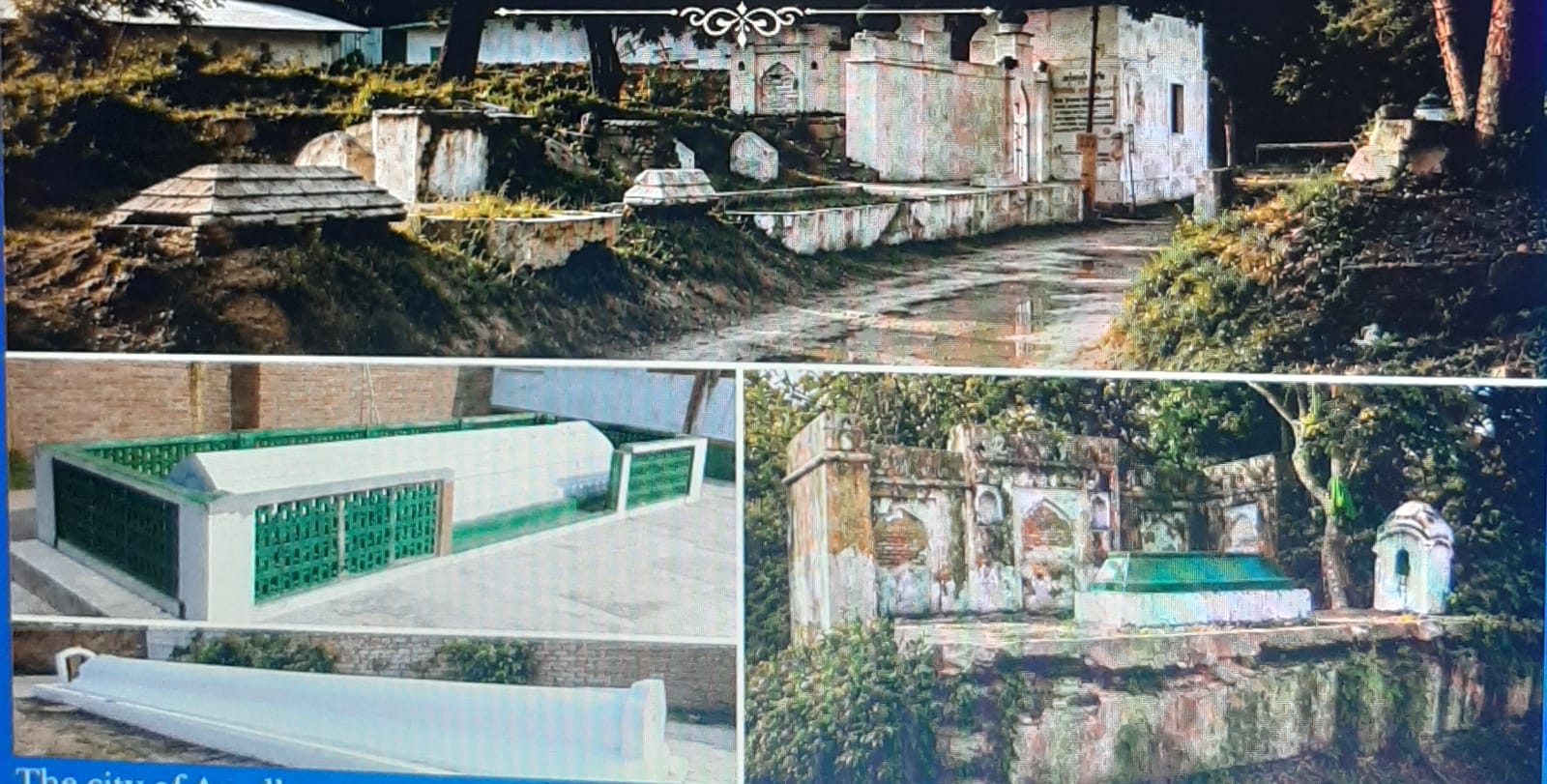
A powerful personal testament to Ayodhya’s deep-rooted Muslim heritage comes from the life of Nasiruddin Mahmud, who lived from approximately 1274 to 1356 CE. He would later become the renowned Sufi saint known as “Roshan Chirag-e-Delhi”, meaning “The Illuminating Lamp of Delhi”. Born and raised in Ayodhya, he was a disciple of the great Nizamuddin Auliya and eventually became his successor. His spiritual lineage and early life in Ayodhya are well documented in historical sources. Remarkably, the shrine of his elder sister, called Badi Bua, still exists in Ayodhya today, serving as a living link to this fourteenth-century figure. His presence, together with the story of his sister’s shrine, offers concrete and humanising evidence of a flourishing Muslim community in the city centuries before the construction of the Babri Masjid.
Sufi Traditions and Religious Syncretism
The Sufi tradition, with its emphasis on spiritual devotion and often its openness to non-Muslims, played a particularly important role in Ayodhya’s Muslim community. The city was home to numerous saints and mystics, including Maulana Daud Pahili, a disciple of the renowned Shaikh Farid of Ajodhan. By the early fourteenth century, there was evidently a market for mystical works in Ayodhya, indicating a sophisticated lay interest in Sufi teachings.
Perhaps most revealing of the city’s spiritual character are the traditions surrounding the tombs of prophets Seth and Job. These impressive graves, measuring six and seven yards in length, were already identified as the resting places of biblical prophets by the sixteenth century, when Abu’l Fazl recorded the popular belief in his Ain-i Akbari. The development of such legends requires considerable time, suggesting that these graves held significance for the local Muslim community long before the Mughal period. The presence of such traditions within a predominantly Hindu city speaks to the complex religious landscape of medieval Ayodhya, where shared sacred spaces and overlapping traditions were likely more common than modern narratives of conflict suggest.
Economic Life and Commerce
Beyond its religious significance, Ayodhya functioned as an important economic centre. The city’s size in the late sixteenth century, estimated at nearly half that of Lahore and Delhi, suggests a prosperous urban community. The merchant Khwajagi Khujandi, a contemporary of Shaikh Nizamuddin Auliya, exemplifies the commercial vitality of Ayodhya. His trade in coarse cloth (pat) from Ayodhya to Delhi reveals the city’s role in regional commerce. Significantly, Khujandi deliberately chose to trade in pat rather than finer cloth, explaining that fine cloth was worn only by “Turks and soldiers” in Delhi, while the poor and dervishes wore pat. This observation reveals a merchant who understood his market and perhaps also embodied the ethical values of Sufi piety.
The presence of a cloth dealer with a capital of over 2000 tankas further testifies to the economic importance of Ayodhya’s textile trade. The city’s markets, including sellers of cooked meat and various commodities, sustained a diverse urban population. This economic vibrancy, combined with Ayodhya’s administrative significance as a provincial capital and later as the seat of a Mughal province, ensured that Muslims and Hindus intermingled in the marketplace as well as in religious spaces.
The Babri Masjid and the Evolving Dispute
The most prominent symbol of Muslim presence in Ayodhya was the Babri Masjid, a mosque completed in 1529 CE under the orders of the first Mughal emperor, Babur. For centuries, the site was a contested space. In the 1850s, during the British colonial era, local disputes were noted, and the administration, in an attempt to maintain order, allowed Muslims to pray inside the mosque while Hindus worshipped outside.
This local conflict was profoundly altered in 1949, when Hindu activists placed idols of Lord Ram inside the mosque. The government ordered the gates locked, and the site became dormant for decades, but the seeds of national conflict were sown. In 1992, the demolition of the mosque by a Hindu mob marked a catastrophic turning point. The event escalated a local dispute into a national flashpoint, unleashing communal violence that killed over 2,000 people. This destruction irrevocably changed the character of the city and its communities.
Shared Urban Space and Collective Memory
Habib’s research reveals that Muslims and Hindus shared the urban landscape of medieval Ayodhya in complex ways. Graves and mango-groves that existed during Shaikh Nasiru’ddin’s youth were later engulfed by the expanding city, suggesting continuous habitation and urban development that accommodated both communities. The presence of Muslim tombs surrounding the mounds of Maniparbat and Kuberparbat further indicates that Muslim burial practices were integrated into the city’s sacred geography.
The coexistence was not without tensions, as evidenced by the occasional conflicts recorded in historical sources. However, the overall picture that emerges from the medieval period is one of a city with substantial populations of both religious communities, engaged in shared economic, administrative, and social life. Ayodhya was simultaneously a Hindu pilgrimage centre and an important Muslim administrative and religious centre, a duality that characterised many Indian cities before the communal divisions of the modern era.
This modern reality of fear and displacement stands in stark opposition to the lived experience of previous generations. Long-time residents of both faiths consistently describe Ayodhya as having a culture of inter-faith harmony that was shattered by outsiders. As one priest of a local Muslim shrine put it, there was “never an iota of communal hatred” among the locals, who historically “were busy saving each other” during times of trouble. This narrative of a shared city, where a Muslim tailor could stitch clothes for the idol of Ram and a Hindu priest might help renovate an old mosque, is a powerful counterpoint to the politics of division that has come to define the city in the national imagination.
The Twenty-First Century: A Community in Transition
In the present day, Ayodhya stands transformed. The Ram Temple has been built on the site, and the city is being reimagined on a grand scale. This has created a stark reality for the local Muslim community, which constitutes a small minority within the old city.
Reports reveal an atmosphere of palpable anxiety and fear among these residents. Many recall the violence of 1992 and worry about their future in the changing city. In the run-up to the temple’s consecration, some Muslim families have seen their properties acquired or demolished, leading to feelings of intimidation and insecurity despite official assurances of safety. The heavy presence of police in Muslim-dominated neighbourhoods reflects the fragile situation.
The lives of individuals such as Iqbal Ansari, the son of a long-time Muslim litigant in the Babri case, illustrate the complex pressures of the era. He has publicly praised the government for the temple, but his stance is seen by many as a symbol of Muslim voices being co-opted in the new Ayodhya, a stark contrast to the fear expressed by others like Meraj, a craftsman who lives in fear of losing his home and workshop.
Conclusion
The historical record presents Ayodhya not as a site of eternal Hindu-Muslim antipathy but as a city where Muslim communities established deep roots over centuries, contributing to its religious, intellectual, and economic life. From the establishment of Islamic institutions in the thirteenth century through the development of rich Sufi traditions and the growth of a vibrant commercial economy, Ayodhya’s Muslim connection was integral to its urban identity. The life of Nasiruddin Mahmud, the presence of the Babri Masjid for over four centuries, and the memories of shared coexistence all testify to this enduring heritage.
Understanding this complex history is essential for moving beyond the polarised narratives that have come to define contemporary discourse about Ayodhya. The city’s heritage belongs not to one community alone but reflects the layered and intertwined histories of India’s diverse populations. As Habib’s scholarship demonstrates, the Muslim connection to Ayodhya is not a recent imposition but a centuries-old relationship that shaped the city’s development and character. Recognising this shared history offers the possibility of reimagining Ayodhya as a symbol not of division but of the rich cultural synthesis that has characterised Indian civilisation, even as the present reality for the city’s remaining Muslim residents remains fraught with uncertainty and fear.