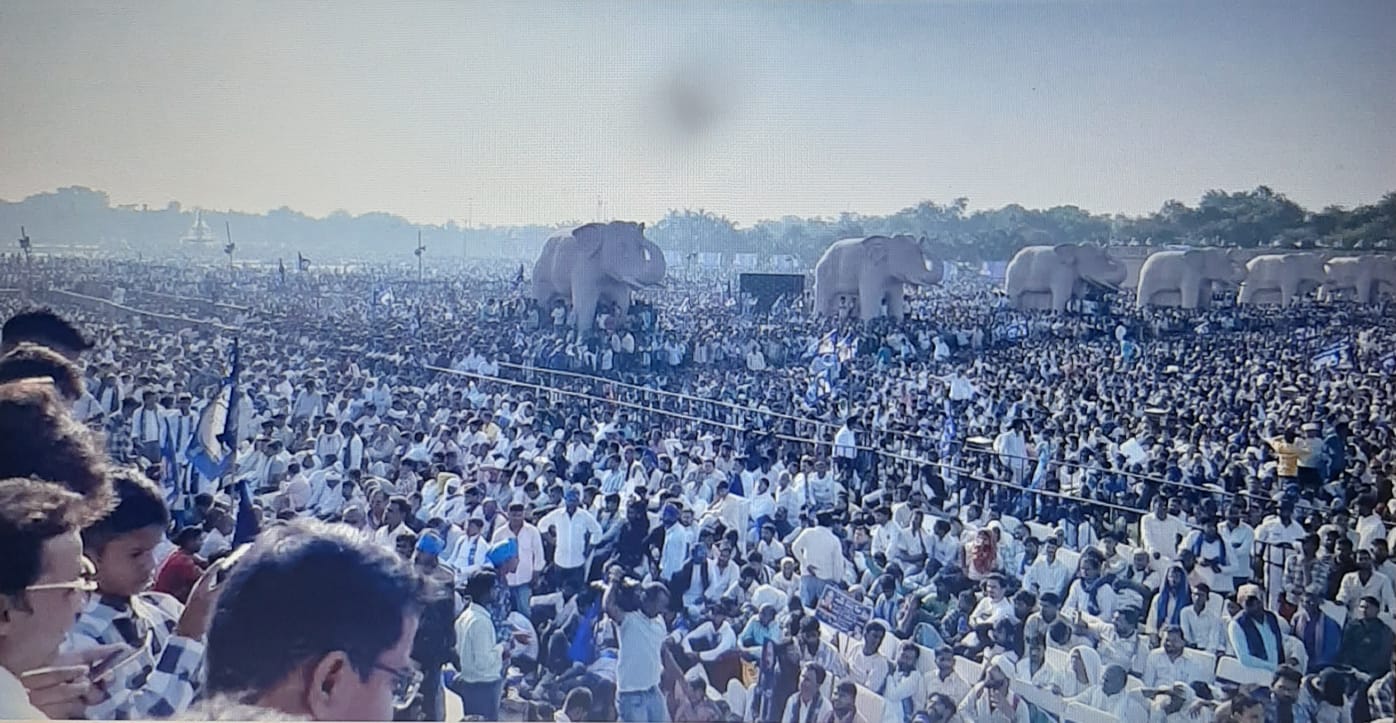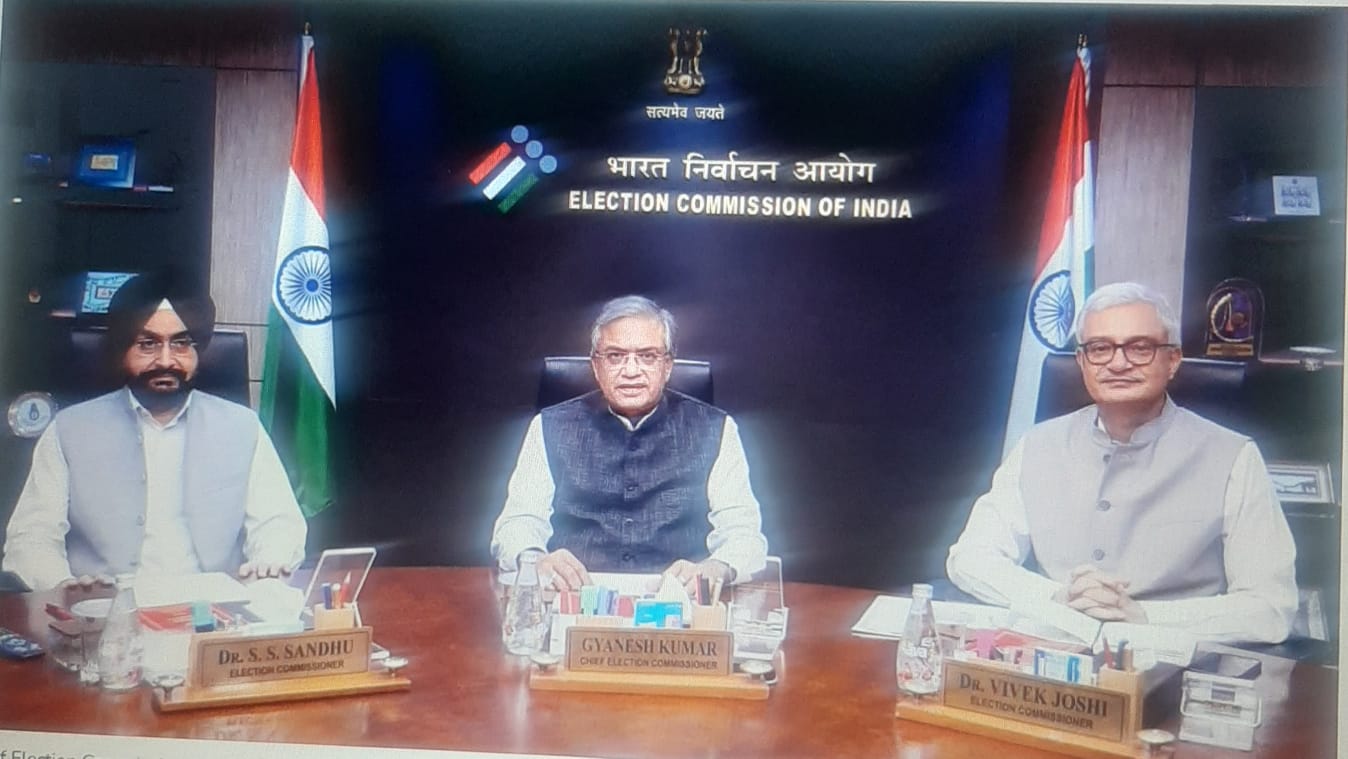


Fanning polarization of voters for winning high stake elections to Parliament and State Assemblies has a long history. Creating an imaginary ‘enemy’ and forcing discussion into simple binaries of ‘good’ and ‘evil’ helps politicians to consolidate their supporters and hide the stark failures in providing governance to citizens. They are emboldened by inaction on the part of constitutional bodies like the Election Commission of India (ECI) which has shown a reluctance to take any action against senior politicians of the ruling party in recent times even at the cost of ECI’s own public credibility, writes former IAS officer Sunil Kumar
If we step back into history then we would recall that in January 2022, the Chief Minister of Uttar Pradesh had stirred a controversy when, while speaking at a conclave organised by Doordarshan in Lucknow he had stated “it will be an 80% versus 20% in UP polls and the BJP will retain power”. He had at the same time added that his party would fight the upcoming elections on the planks of nationalism, good governance, and development.[i] The Opposition had then alleged that this was an attempt to inflame communal passion ahead of the Assembly elections in 2022. BJP had gone ahead and retained power in UP albeit with reduced number of seats.
In the high stake elections in Bihar in 2025, we had the spectacle of a Union Minister articulating in public that voters belonging to a particular community, who do not vote for the BJP despite being recipients of ‘free foodgrains’, housing and other welfare schemes of government, are ‘namakharams’ or disloyal. He did not use the same phrase or term to describe the voters belonging to the majority community who do not vote for the ruling party. In the current cycle of state elections, particularly in Assam and West Bengal, the focus is again on ‘ghuspaithiye’ (illegal Muslim immigrants from Bangladesh) even when the Government and the Election Commission shy away from giving any authoritative figures regarding illegal immigrants detected during ongoing Special Intensive Revision (SIR) of electoral rolls in the state.
Fanning polarization of voters for winning high stake elections to Parliament and State Assemblies has a long history. Creating an imaginary ‘enemy’ and forcing discussion into simple binaries of ‘good’ and ‘evil’ helps politicians to consolidate their supporters and hide the stark failures in providing governance to citizens. They are emboldened by inaction on the part of constitutional bodies like the Election Commission of India (ECI) which has shown a reluctance to take any action against senior politicians of the ruling party in recent times even at the cost of ECI’s own public credibility.
In the recent past action by the ECI has been limited to putting a temporary ban (ranging between 48 to 72 hours) from electionering on some politicians like Yogi Adityanath, Mayawati, Anurag Thakur and Kapil Mishra for violation of the model code of conduct. When it has comes to senior politicians like the Prime Minister and the Union Home Minister, the ECI has delayed decision and restricted itself to issuing warning/advisories to be communicated to the concerned high dignitaries through the Party President long after electioneering had ended and the damage had been done. Earlier in the 2014 general elections, the ECI had imposed a ban on campaigning by Amit Shah and Azam Khan although the ban on Amit Shah was later revoked with certain conditions. Post 2020, the ECI has restricted itself to just issuing advisories and warnings although violations of model code of conduct have continued unabated.
This brings to the fore the central issue of secularism in India. The preamble of the Indian Constitution describes India as a sovereign, socialist, secular and democratic republic. The words ‘socialist’ and ‘secular’ were inserted through the 42nd Constitution Amendment Act (CAA) during the emergency years. It is the contention of a certain section of academics and politicians[ii] that they do not constitute part of the basic structure of the constitution as the Constituent Assembly had rejected the insertion of the word secularism in the Indian constitution. However, as recently as in 2024, the Supreme Court has held that secularism is a basic feature of the Indian constitution.[iii] It specifically noted that moving a petition challenging the insertion of the words ‘secular’ and ‘socialist’ in the Preamble after 44 years of the 42nd CAA rendered the prayers of the petitioner questionable. Thus, the efforts of a certain section of the polity to use the judicial route to get the words ‘secular’ and ‘socialist’ removed from the Preamble came a cropper.
It is also important to note that following a 1989 amendment to the Representation of People’s (RP) Act, 1951[iv], through Section 29A (5) it has been made mandatory for all political parties to have a specific provision that ‘the association or body shall bear true faith and allegiance to the Constitution of India as by law established, and to the principles of socialism, secularism and democracy, and would uphold the sovereignty, unity and integrity of India’ in their memorandum or rules and regulations.
Section 123 (3) of the RP Act, 1951 has included interalia appeal to voters on grounds of religion by the candidate or his agent in the list of ‘corrupt practices’. However, it seems this can be made part of an election petition and be enforced by a court of law and not the ECI. Further, Section 125[v] of the RP Act, 1951 lists prominently, in the long list of electoral offences, the act of promoting enmity between classes in connection with election. To quote “Any person who in connection with an election under this Act promotes or attempts to promote on grounds of religion, race, caste, community or language, feelings of enmity or hatred, between different classes of the citizens of India shall he punishable, with imprisonment for a term which may extend to three years, or with fine, or with both.”
Given these stringent provisions already contained in the RP Act, 1951, it is ironical that the ECI has, till date, not disqualified any political party on grounds of not being committed to secularism. The argument in defence of ECI could be that the onus of the electoral offence has been placed on the candidate and/or his agent and not the political party. Likewise, there is perhaps no instance of any person getting punished for promoting enmity between classes in connection with election.
What we have instead is one case[vi] where the constitution bench of the Supreme Court held that seeking votes in the name of religion, caste or community as laid down in section 123(3) of the RP Act,1951 amounted to corrupt practice and the election of the BJP candidate Abhiram Singh to Maharashtra Assembly in 1990 had been rightly set aside by the Bombay High Court on the ground that he made an appeal to the voters as a Hindu. Here action was taken against the candidate by the High Court as an individual on an election petition. The possibility of several such cases by other candidates (either then or in subsequent elections) cannot be ruled out although no action was taken against them in the absence of election petitions.
Political parties have been delisted by the ECI for not contesting elections or failing statutory filings such as election expenses. In August and September 2025, the ECI delisted 808 Registered Unrecognized Political Parties (RUPP) on grounds of not contesting elections in the past six years, being non-existent at their given address or non-submission of list of office bearers since 2014. However, the ECI has taken the stand in various courts that it cannot deregister parties on grounds like religion-based conduct or caste appeals due to lack of explicit statutory provisions empowering the ECI.[vii]
The present stand of ECI needs to be seen with reference to the stand taken by the then CEC T.N.Seshan who had in 1995 taken the extreme step of canceling the Bihar Assembly polls citing massive electoral malpractices, booth capturing and breakdown of law and order which had created conditions wherein the ECI found it impossible to conduct free and fair elections as mandated by Article 324 of the Indian constitution. This step had evoked strong reaction from the political class and critics had argued that there was no explicit statutory provision which empowered the ECI to take such an extreme step. The ECI and it’s supporters had argued that Article 324 gave residual powers to act in situations where law is silent. In the Mohinder Singh Gill vs Chief Election Commissioner case the Supreme Court had held that Article 324 allows the ECI to act in areas not specifically covered by legislation, as long as it ensures free and fair elections. This has been consistently upheld in several subsequent judgments of constitutional courts.
In the past the ECI has taken recourse to exercising plenary powers (where there is no explicit legal provision) in order to ensure free and fair elections. Since the power to register political parties is with the ECI, it stands to reason that the power to deregister a political party should also lie with the same authority especially when the law is silent on this score.
It is the Constitution of India which is the guiding star for all institutions and stakeholders operating in the Indian republic. If secularism is a basic feature of the Indian Constitution, any action on the part of any stakeholder which goes against the constitutional mandate should be punishable in law. Political parties are major stakeholders in Indian democratic system. All political parties registered by the ECI are sworn to upholding the constitutional values including the principle of secularism enshrined in the Indian Constitution. Hence not only attacks on the secular fabric of the country by candidates and their agents in their individual capacity be punished under law but the political parties too, which sponsor such candidates and stand to benefit if those candidates win the elections, be made accountable. If it is established that candidates put up by the party and it’s ‘star campaigners’ have indulged in action which strike at the root of the secular fabric of the country then ECI would perhaps be justified in initiating action against errant candidates and political parties.
During the period of elections (from the date of announcement of the election schedule till the day of declaration of results) the ECI wields enormous powers where even the scope of intervention by the judiciary is limited by law. Use of corrupt practice by candidates as well as the political parties during the period of elections must be barred if free and fair elections are to be held. The onus of preserving the constitutional values and sanctity of elections by candidates and political parties lies squarely with the ECI during the period of elections. In my view, the ECI should not hesitate to use it’s plenary powers to take the extreme step of deregistering a political party and barring it from contesting elections if the party or candidates sponsored by the concerned party are found indulging in corrupt practices including violation of Section 123(3) of the RP Act, 1951 read with section 29A of the said Act.
Critics would see a red herring in the aforesaid proposal and would allege that this could provide another tool in the hands of the ECI to take partisan action against the opposition parties and letting the ruling party/alliance go ‘scot free’ given the dubious record of the ECI especially in the last few years. It will not be an exaggeration to state that the manner in which the ECI has responded to fair queries/ complaints of the opposition parties and the summary manner in which they have been treated (in sharp contrast to it’s treatment of queries/complaints received from the ruling alliance) has created grave doubts about the ‘neutral’ status of the ECI in the democratic electoral process. So much so that the opposition parties have for the first time given a notice to impeach the Chief Election Commissioner!
However, it must be remembered that the ECI is a constitutional body and had earned a reputation of being a ‘relatively autonomous institution with a distinctive identity deriving from the democratic logic of the state’ as Singh & Roy have put it.[viii] Over the years the ECI had displayed a remarkable ability to renew itself, despite flaws in its design, and had actually enhanced its powers inscribed in the Constitution itself. This had been done by successive Chief Election Commissioners. Hopefully, the present would be seen as an ‘aberration’ and not the norm.
Secularism is being put to test not only at the time of elections but also otherwise. The boundaries of secularism are increasingly being tested by different political parties. Since political parties are at work even when elections are not being held, it stands to reason that their action is critically evaluated especially when it seems to be going against the provisions of section 29A of the RP Act, 1951. This would expand the power of the ECI over registered political parties. Appealing for votes in the name of religion, is clearly a corrupt practice (section 123(3) of RP Act, 1951) and an electoral offence (section 125 of RP Act, 1951) and, in my view, should be used by the ECI to first threaten deregistration of political party and finally deregister such political party after giving due opportunity to explain in writing and even hearing in person. It would mean exercise of plenary power by the ECI. Such action would also serve as a deterrent for political parties and their leaders and they would then take care to rein in their deviant party candidates and their agents. This step would go a long way in strengthening Indian democracy.
(Sunil Kumar is a visiting Senior Fellow associated with the Centre for Cooperative Federalism & Multi-level Governance in Pune International Centre and a former civil servant. Views expressed are personal.)
[i] Yogi’s ‘80%- 20%’ remark bid to inflame communal tension: Oppn – By HT Correspondent, Hindustan Times, New Delhi, Jan 11, 2022 12:07 AM IST
[ii] https://www.facebook.com/drjitendras/videos/the-words-socialist-and-secular-where-never-a-part-of-the-preamble-of-the-origin/716175378039603/
[iii] Writ Petition (Civil) No 645 & 1467 of 2020; Dr. Balaram Singh & Ors. Vs. Union of India & Ors.; SC, Nov.25, 2024
[iv] Ins. by Act 1 of 1989, s. 6 (w.e.f. 15-6-1989).
[v] Ins. by Act 40 of 1961, s. 24 (w.e.f. 20-9-1961).
[vi] Supreme Court judgment dated 2.1.2017 in Civil Appeal No.37/1992, Abhiram Singh v C.D.Commachan (dead) mentioned in the book ‘Election Commission of India’ by Ujjwal Kumar Singh & Anupama Roy; Pg.345-346, Oxford University Press, 2019;
[vii] www.hindustantimes.com/cities/lucknow-news/not-empowered-to-deregister-political-parties-for-holding-caste-rallies-eci-to-high-court-101761939247316.html
[viii] ‘Election Commission of India’ by Ujjwal Kumar Singh & Anupama Roy; Pg.347, Oxford University Press, 2019;