

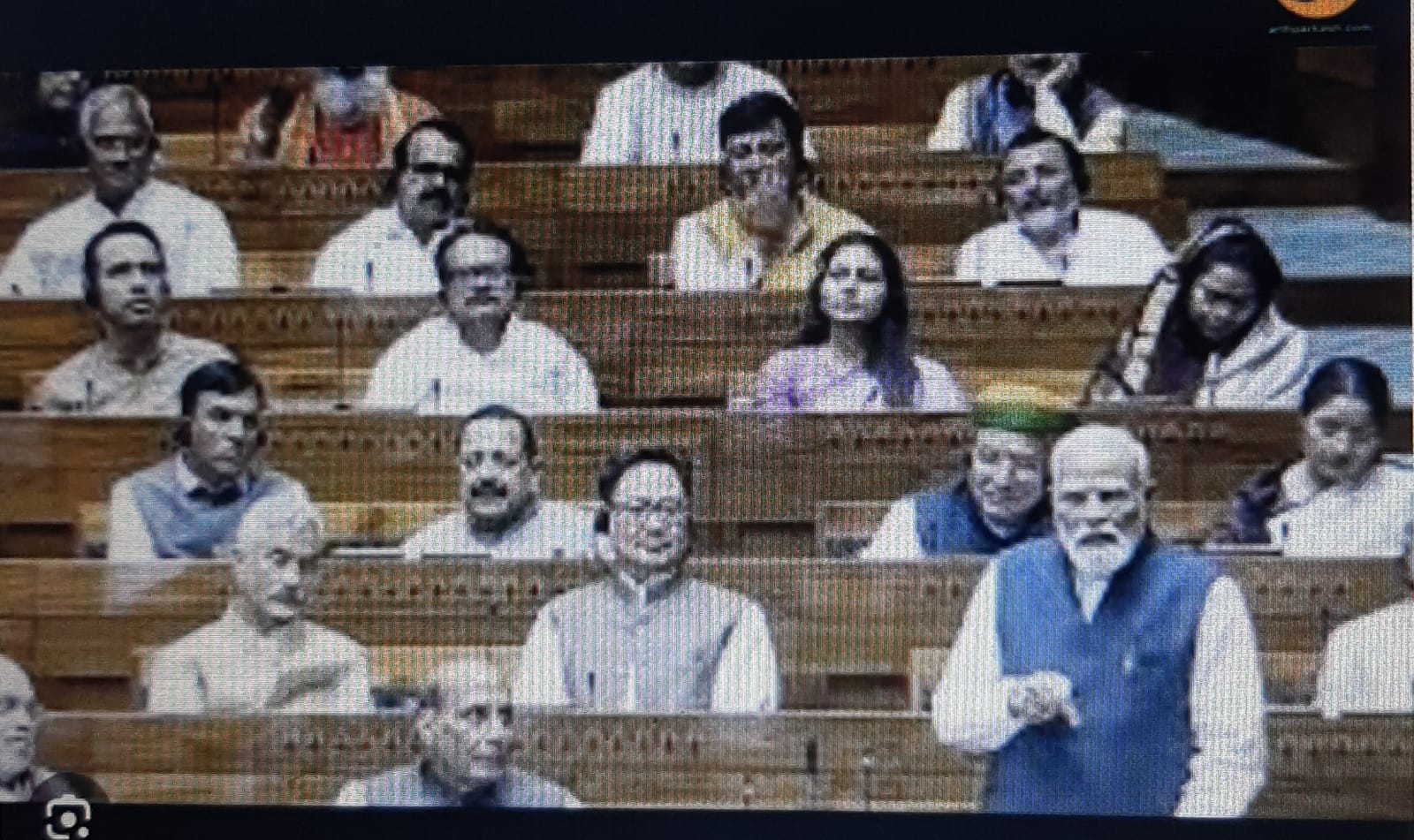
India’s democratic ambitions merit more than numerical incrementalism. They deserve harder work: empowering local governments, strengthening parliamentary committees, cleaning up campaign finance, and building the anti-defection and institutional reforms that would give each existing MP a genuine stake in representing their constituents rather than their party bosses. That, not an inflated roster, is what would make Indian democracy more meaningfully vibrant, writes former IAS officer V.S.Pandey
Recently, the Indian parliament refused to pass the constitutional amendment bill to increase the size of Lok Sabha and state legislatures by 50 percent, consequential delimitation exercise and enable the 33 percent quota for women . With the population crossing 1.4 billion, voices within the ruling establishment and outside have begun making what seems like an eminently reasonable argument: our constituencies are too large, our MPs too distant from the people they serve, and it is time to expand the Lok Sabha significantly beyond its current 543 seats.
It only sounds reasonable. It is not. A hard look at the experience of mature democracies — and at the actual sources of India’s democratic deficits — reveals that expanding Parliament would be a costly distraction from the reforms that would actually bring government closer to the people.
“Every major democracy that has recently voted on the size of its legislature has chosen to make it smaller — not larger.”
THE NUMBERS BEHIND THE CLAIM: India’s current ratio stands at roughly one MP for every 2.5 million citizens — a figure that strikes many observers as scandalously large. The comparison with the UK, where each Member of Parliament represents approximately 100,000 constituents, feels damning. But this comparison, deployed without context, is misleading in an important way: the United Kingdom has not made its Parliament larger to bridge that gap. Nor has any other major democracy concluded that the solution to the problem of scale is simply to add more legislators. The salient development indices of these nations exemplify their superior governance.
The United States House of Representatives has been capped at 435 members since 1929, even as the population has grown from 106 million to over 340 million. Each Congressman now represents roughly 780,000 Americans. There is no serious mainstream movement to double or triple the size of the House. America’s democratic dysfunction — and it is considerable — flows from money in politics, polarization, and institutional gridlock, not from having very few representatives.
EUROPE VOTES TO SHRINK, NOT GROW: If anything, the global trend runs in precisely the opposite direction. In 2020, Italy held a constitutional referendum on whether to cut its Parliament by a third — reducing the Chamber of Deputies from 630 to 400 members and the Senate from 315 to 200. The measure was passed with a remarkable 70 per cent of the vote. Italian citizens, when directly consulted, did not feel that fewer representatives would leave them less heard. They felt it would make the institution less bloated, less expensive, and less susceptible to the patronage politics that a large legislature enables.
Germany offers a cautionary tale from the other direction. Its Bundestag, swollen to 736 members through the mechanics of its mixed-member proportional system, became so large as to be logistically unwieldy. The German Parliament passed a law in 2023 to cap and reduce its size. More legislators created more confusion, not more democracy.
Meanwhile, the world’s most celebrated democracies — the Nordic countries — operate with remarkably small national legislatures. Denmark governs six million people with 179 members of the Folketing. Norway, Finland, and Sweden follow similarly lean models. These countries consistently top global indices of democratic health, government effectiveness, and citizen satisfaction. Their secret is not numerical but structural: strong local self-government, genuine devolution of power, and accountable political parties.
“India’s real representation deficit is not in Parliament. It is in the panchayat and the municipal ward — hollowed out by decades of deliberate under-empowerment.”
INDIA’S REAL DEMOCRATIC DEFICIT: The proximity argument — that people need their MP to be physically and administratively closer — rests on a fundamental category error. An MP’s job is to legislate, deliberate, and hold the executive accountable. A constituent’s day-to-day interface with the state — getting a road repaired, resolving a land dispute, accessing a hospital — is supposed to happen at the panchayat and municipal level.
The 73rd and 74th Constitutional Amendments of 1992 promised exactly this: a genuine third tier of elected government with devolved functions, finances, and functionaries. Three decades on, that promise remains largely unmet. Most panchayats are starved of funds, stripped of real powers, and held hostage to state government patronage. It is this failure — not the size of the Lok Sabha — that has left hundreds of millions of citizens without meaningful local representation.
Add 200 more MPs and you do not fix that problem. You simply create 200 more intermediaries competing for the same political patronage, the same government contracts, and the same party’s high-command favor that already distorts representation in the existing House.
THE DELIMITATION QUESTION THAT ACTUALLY MATTERS: This is not to say that India’s delimitation process does not pose a serious equity problem — it does, but a different one. The freeze on constituency numbers since 1976, extended to 2026, was a political compact designed to avoid penalizing states that had successfully controlled population growth. As that freeze lifts, states in the north — which grew faster — will expect greater representation, while southern states fear losing seats- despite having invested more in human development.
This is a genuine constitutional tension, and it deserves a serious political solution — perhaps a revised formula that rewards both population share and demographic achievement. But that solution does not require, and indeed is not helped by, simply inflating the total number of seats.
Similarly, India’s Women’s Reservation Act of 2023 — which promises one-third of seats for women — is a genuine structural reform that will change who represents the people, not just how many do. That is the right kind of reform: targeted at quality and equity of representation, not at the headcount of legislators.
QUANTITY IS NOT QUALITY : There is something seductive about the arithmetic of democracy — the idea that more representatives must mean more representation. But democratic quality is not a function of headcount. It is a function of accountability, deliberation, and genuine responsiveness to citizens’ needs. A House of 800 MPs- where proceedings are already so disrupted that Parliament sits for fewer days each year, would not be more deliberative — it would be more chaotic.
The fiscal cost alone should give pause. India’s MPs already draw from a generous pool of salaries, housing, staff allowances, and the Members of Parliament Local Area Development (MPLAD) funds. Scaling that up by 30 or 40 per cent would represent a significant drain on the public exchequer for no demonstrable democratic dividend.
India’s democratic ambitions merit more than numerical incrementalism. They deserve harder work: empowering local governments, strengthening parliamentary committees, cleaning up campaign finance, and building the anti-defection and institutional reforms that would give each existing MP a genuine stake in representing their constituents rather than their party bosses. That, not an inflated roster, is what would make Indian democracy more meaningfully vibrant.
(Vijay Shankar Pandey is former Secretary Government of India)