

Shakespeare’s Hamlet differs significantly from the revenge tragedies of his period, in that his play questions the very morality of the idea of revenge. Foul deeds poison the state and society and it is amidst this darkness that the moral courage and ethical decisiveness of Hamlet (and Horatio) shine bright. We pay a heavy price for a corrupted state. And the true leader is one who negotiates deceit, cheating and fraud through personal morality and an astute countering of evil by its proven public disclosure before dispatching it writes Juthika Patankar, a former civil servant.
‘The Tragedy of Hamlet, Prince of Denmark’ (hereafter referred to as “Hamlet”) is William Shakespeare’s most famous play, his longest play, with a powerfully dominating central character, and a play which is perhaps the most critiqued piece of literature in the world.
Written between 1599 and 1601, “Hamlet” reflects all the trends in the drama of that age. It could be variously described as a revenge tragedy, a murder mystery, or philosophical take on the conflict between indecision and action. Critics have argued about its political interpretation, its deflection from Christian theology, its debate about the full meaning and implications of revenge. In modern times, the themes of feminism and the Freudian Oedipus Complex have also been examined.
“Hamlet” has long been a staple of English literature courses in India. It has been translated and adapted in full or in part and its many themes have crept into common culture across the world. English is widely spoken in India and Indians routinely use many phrases from the play in everyday speech. In this context, what is the particular relevance, if any, of “Hamlet” in modern India? How do its themes relate to the pressing questions of our time? This essay attempts to provide an answer to this.
The plot of “Hamlet” centres on the Prince of Denmark who has returned home from the University of Wittenberg to attend the funeral of his father, the late King. At the court he presents a gloomy figure. He is unhappy at the loss of his father and equally oppressed by the knowledge that his mother has so swiftly entered into marriage with the new King, his father’s brother. The new king is in celebratory mood and his jovial pronouncements and almost exuberant graciousness in the conduct of his court stands out in stark opposition to Prince Hamlet’s melancholy aspect. Soon after, Hamlet is informed by the ghost of his father, who appears on the battlements of the castle, that he, the late king, was murdered by his brother who subsequently took both his throne and his queen. And so he, Hamlet, must avenge the death of his father by killing the king but he must also ensure that his mother is not harmed. How Hamlet carries out the ghost’s exhortations and what he learns about life, death, morality and kingship is what constitutes the rest of the play.
My purpose here is not to write yet another literary analysis of “Hamlet” but to examine its major themes in the context of our times. These themes are: the state of the body politic, corruption and deceit, patriarchy, rationalism and above all, the morality which informs the hero’s decisions and actions.
“Something is rotten in the state of Denmark”. Here the state includes not just the political state but also the state of society, of relationships, of friendships and the ordinary civilised discourse of human lives. The “murder most foul” of the King of Denmark and the usurpation of his throne by his greedy and evil brother is an act which poisons the state of Denmark. Ordinary trust and decency is replaced by suspicion and deceit, plotting and counter-plotting. Sycophancy becomes the order of the day. The state is ruled by indulgence in hedonistic pleasures, a continuous show of pomp and bombast, and dishonesty and dissemblance in transactions among persons of high or low rank. Crimes committed at the apex of the body politic reverberate through not only the body. They impact the moral fibre of social and political life as a whole.
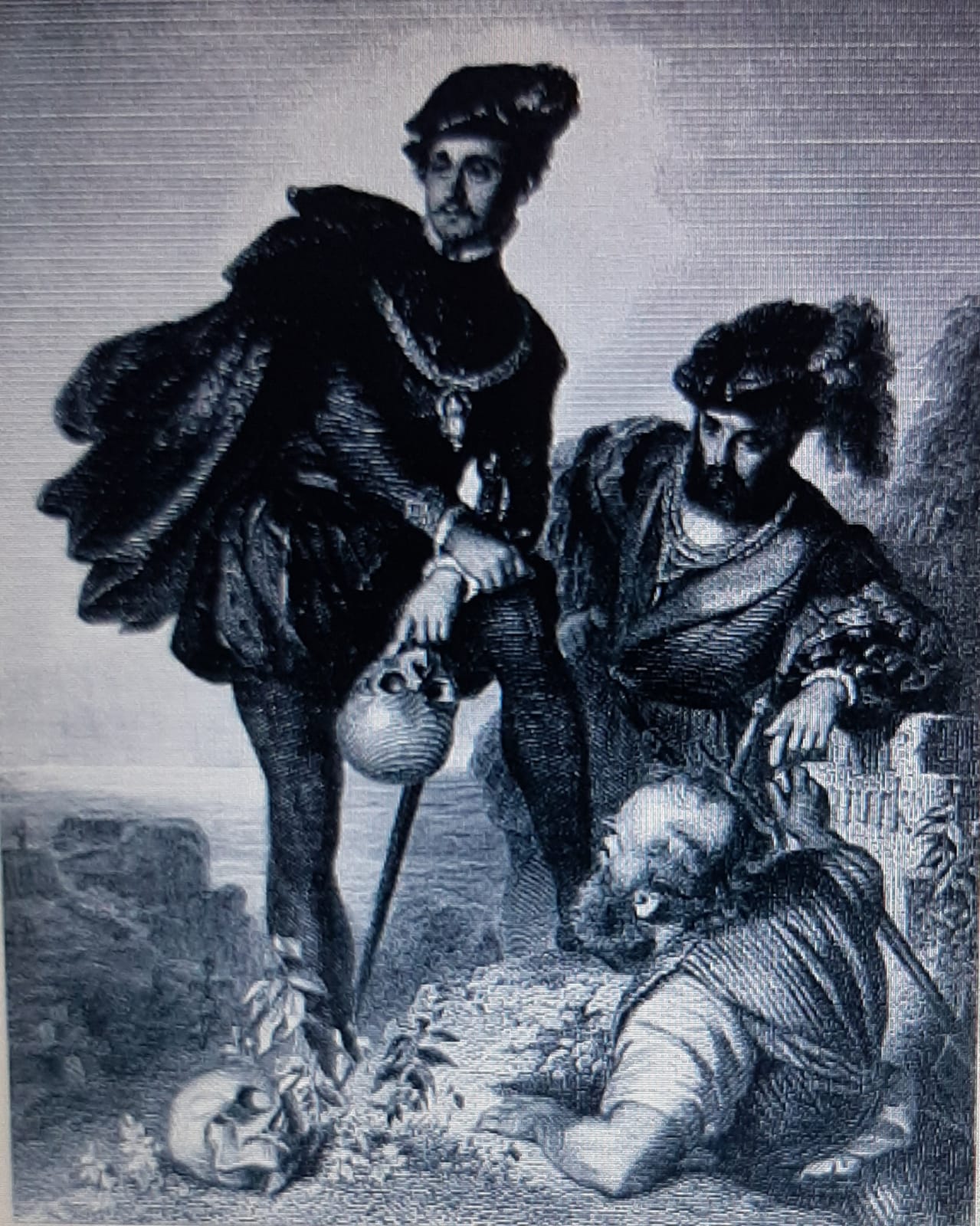
In such an atmosphere of ethical debauchery and corruption, can one man, with the noblest of motives, ‘ set the world right’? Hamlet’s heart and mind are riven with the conflicting nature of revenge. On the one hand, it appears in the nature of justice to kill the man who murdered his father, but on the other hand, does not the very act of such killing taint him too and bring him down also to the same level of being a murderer? And yet is not inaction unforgivable in the face of rank injustice. Hamlet resolves at one stage to strike down the king only to see him at prayers. He refrains, therefore but ironically the king is heard to say at the conclusion of his prayer that his words go to Heaven but his thoughts lie below. Deceit and treachery affect friendships as also the relationship between father and daughter and resultantly between this daughter and Hamlet, whose beloved she is. Hamlet’s university friends agree to treachery against him in pressing their sycophancy on the king. And the duplicitous behaviour of the fawning courtier Polonius sees him die, unwittingly, by Hamlet’s hand. In such a world of corruption, betrayal, greed and intrigue, Hamlet has to resort to pretending to madness in order to discover the truth.
Patriarchy is the order of the day in “Hamlet”, as in times immemorial including our twenty-first century. Hamlet’s beloved, the innocent and gullible Ophelia is used as a pawn by her father in furthering his interests at court.The character of Hamlet’s mother, Gertrude, is also presumably has her affections manipulated by her husband’s brother and then she is subjected to utter reviling and contempt through the chafing of her own son. She becomes another puppet in the intrigue, not able to save her own son from being slain treacherously by her husband. Hamlet’s frustrated cry at Ophelia, “Frailty, thy name is woman” is actually rich in irony.
Medieval Europe in the age of Shakespeare was not an age of rationality. Beliefs in the supernatural and in ghosts, omens and portents was widespread. The ghost in “Hamlet” is also not free from ambiguity. As implicit belief in a ghost’s utterances would not square with Christianity, Hamlet has to conduct a test to prove the king’s guilt before he can act on the ghost’s injunctions. Blind faith cannot determine any course of action and certainly not for the student at University that Hamlet is.
Appearances and ‘seeming’ are important issues in “Hamlet”. Nearly everybody with the notable exception of Hamlet’s friend Horatio is pretending to be what he or she is not. Trust is conspicuously absent in public as well as private spheres. The parallels are evident not only with our times but with all troubled times in history. How then must Hamlet act?
There is the private persona of the prince who shuns false action by not killing the king at prayer, by expecting honesty from his avowed friends, by his grief and betrayal upon finding that Ophelia was also only pretending to be what she was not. He is gracious, forgiving and genuinely contrite towards his opponents where he believes he has wronged them and roused their ire. But then there is the public persona or rather the king-in-making, capable of turning the tables on the traitors around him by expertly thwarting them at their own games. He meets his end, honourable to the last because he has accepted the challenge of a fair duel only to have a poisoned sword thrust into him and he is ultimately goaded to drive the same sword through the king when he realises his mother is dying of poison in her cup of wine.
The play ends with the principal characters all dead save for Hamlet’s friend, Horatio, who has been been restrained from committing suicide by Hamlet in order that he may tell his story to the world. The kingdom of Denmark is taken over by the armies of the neighbouring prince Fortinbras of Norway who is also avenging his own father’s former defeat. And in the fitting final tribute to Prince Hamlet, Fortinbras commands that Hamlet’s body be borne
“…like a soldier to the stage,
For he was likely, had he been put on,
To have proved most royal; and for his passage,
The soldier’s music and the rite of war
Speak loudly for him.”
Shakespeare’s Hamlet differs significantly from the revenge tragedies of his period, in that his play questions the very morality of the idea of revenge. Foul deeds poison the state and society and it is amidst this darkness that the moral courage and ethical decisiveness of Hamlet (and Horatio) shine bright. We pay a heavy price for a corrupted state. And the true leader is one who negotiates deceit, cheating and fraud through personal morality and an astute countering of evil by its proven public disclosure before dispatching it.
The themes of the play are timeless and based on universal human values. At its heart is a philosophical debate and endless questioning of issues in all their hues and if any one individual presumes to believe that he alone can set the world right he learns the hard way that there are simply no easy or morally acceptable solutions. We too at present find ourselves in morally ambiguous times where sycophancy and deceit and blind faith appear to prevail over ethicality, integrity and honest questioning. “Hamlet” offers much food for thought and holds up an uncomfortable mirror to our age.
(Ms. Juthika Patankar is a visiting faculty in Gokhale Institute of Politics and Economics, a member of Pune International Centre and a former civil servant. Views expressed are personal.)