

Civilised modern society is expected to live by rules framed by consensus for the greater good of all. Unless these rules are adhered to scrupulously for the collective well-being of society, negligence, callousness and complete lack of accountability would result. Human lives would become cheap and corruption and cheating would eventually destroy humans and humanity. The onus to remedy this current horrific state of affairs lies squarely on all of us, as the different components who make up our community, society and the nation writes Sunil Kumar, a former civil servant.
Scores of people lose their lives in ‘accidents’ in different parts of the country on a regular basis. Pedestrians/ cyclists being mowed down by speeding vehicles do not even elicit a condolence message. News regarding vehicles catching fire on highways and passengers being burnt alive are tucked away in the inside pages of a newspaper. Vehicles falling into gorges, people getting killed in train and air accidents routinely or in buildings catching fire may catch public attention, elicit a condolence message from the political leaders and announcement of compensation from the Chief Minister’s or Prime Minister’s (or both) Relief Fund and setting up of a magisterial inquiry to fix responsibility. In very serious cases, we have the Minister or the Chief Minister tweeting that the ‘culprits will not be spared’ – a standard sickening phrase which means nothing. By next day, new events overtake the previous ones and the cycle of predictable responses start afresh. Even the authorities forget their public commitments almost as soon as they are made!
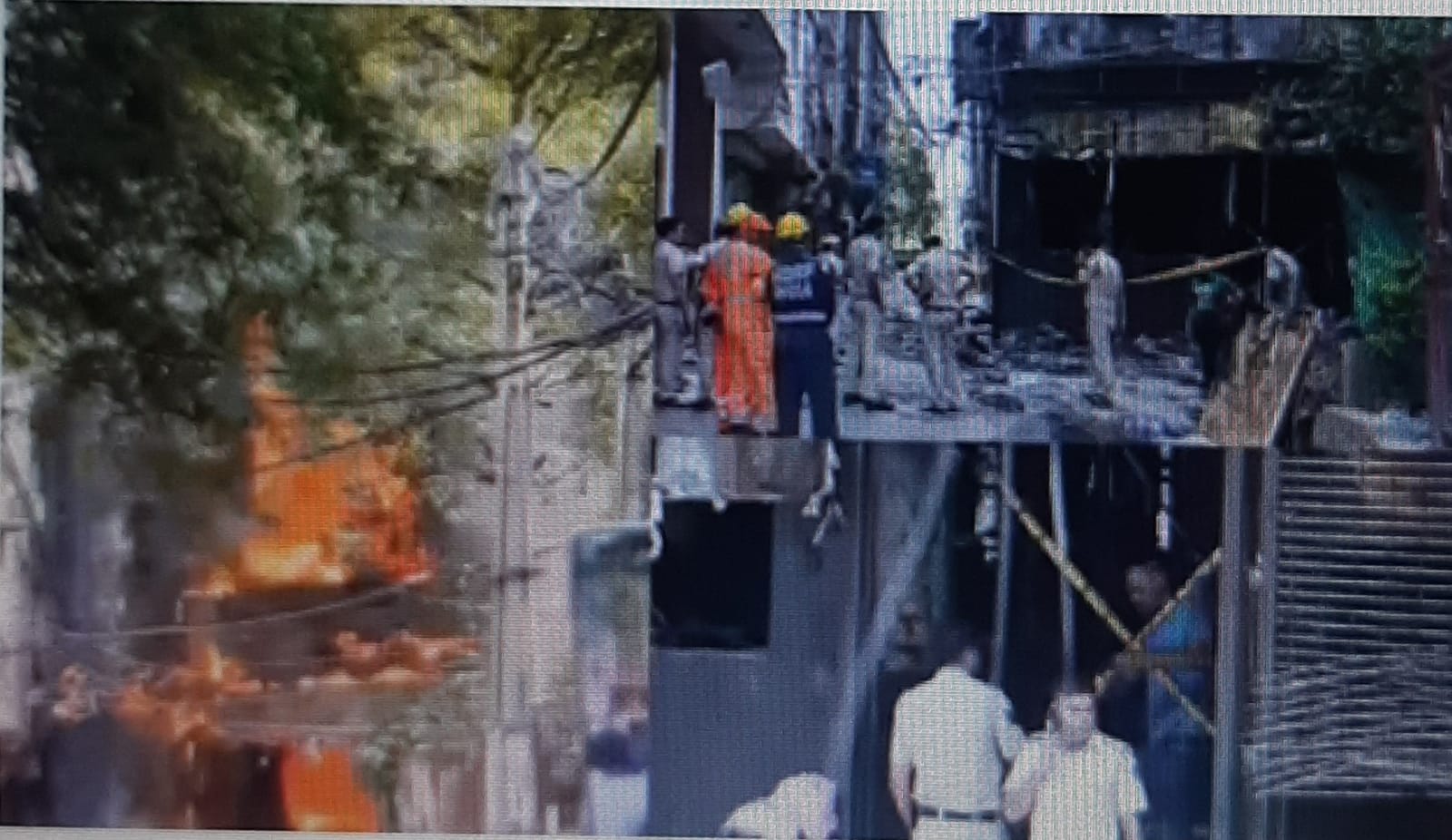
No wonder, the death of 21 persons in a hotel blaze in Malviya Nagar in Delhi on 3rd June, 2026 will soon be forgotten. In the digital age, public memory is short. Bigger tragedies such as the death of scores of pilgrims in the Kumbh Mela at Prayagraj in 2025, or in the stampede at New Delhi Railway Station have been forgotten. Payment of a few lakh rupees as compensation is the best that the family of the hapless victims can expect. The fixing of accountability and learning from past mistakes is an unheard-of phenomenon in Indian conditions. Most people would not even remember that there was a time when the then Railway Minister Shri Lal Bahadur Shastri had resigned owning moral responsibility following a train accident in the 1950s!
To focus on the latest tragedy, editorials have been written labelling the Malviya Nagar incident a ‘capital tragedy and a national shame’.[i] The editorial concludes with the hope that ‘tragedies like these may be a wake-up call, but they must be followed by sustained attention, apart from demands for accountability.’ It would be interesting to do some research and find out as to how many wake-up calls the system has received in different parts of the country in the last so many decades and whether we continue to sleep like the mythological Kumbhakarna, brother of Ravana. Now that ‘Ram Rajya’ is officially established in the states where ‘triple engine’ government is in power, it is ironical that the administrative system refuses to wake up!
‘Fix accountability’ is one of the clarion calls that one gets to hear in the aftermath of tragedies that rock different cities and states with unfailing regularity. In the instant Malviya Nagar case too what we are getting to see is the great Indian circus with the Police, the Municipal Corporation of Delhi (MCD) and the government departments shifting blame onto one another over lapses and approvals. This same circus will play out in the hospital fire incident which has happened in Muzaffarpur in Bihar where hospital staff fled from the scene when fire engulfed the hospital. In December 2011, fire in the Dhakuria branch of AMRI hospital in Kolkata had left 89 patients dead and we had witnessed similar scenes. The incident had triggered nationwide scrutiny of hospital fire safety. But can any state or municipal authority guarantee that all hospitals operating in their area conform to fire safety norms? The answer would be a resounding No.
When this is the situation in the national capital and state capitals, where the authorities have the resources to undertake such fire safety audits and plug the shortcomings and yet fail to do so, then something is rotten in the state. Why does the system fail so often? The short answer is that we do not value the life of ordinary citizens and so we do not believe in adhering to safety procedures or protocols.
The regulatory systems put in place work more like extortion rackets. All permissions and clearances can be obtained after paying a bribe. A full-fledged and vibrant service sector is flourishing employing hundreds of persons who specialize in getting things done from different offices. Government declares that the whole system has been computerized; files can be tracked on the dashboard; applicants are sent the status of their applications on their mobile etc.. The hard truth is that unless bribes are paid, no paper moves. Government is unwilling to accept that corruption is an issue. If anyone talks of corruption in government, then s/he is supposedly spreading rumours (since state policy is zero tolerance of corruption) and runs the risk of being hounded by the government agencies.
A plethora of departments and agencies operating in the field and answerable to no single authority such as the Municipal Corporation or the State or the Union Government, seems to guarantee that no responsibility of any kind can ever be fixed on any official of any government department or agency. For instance, in Delhi the police department functions directly under the Union Home Ministry. Delhi Development Authority (DDA) reports to the Ministry of Housing & Urban Affairs. Fire Services are under the Home Department of Government of NCT of Delhi. Prior to 1994, it was under the Municipal Corporation of Delhi (MCD). The department authorizing ‘Bed & Breakfast’ stays is the Tourism Department under the Delhi Government and the authority sanctioning building plans functions under the MCD. Then, there are the ‘Lal Dora’ urban villages in Delhi which are exempt from municipal building norms. Similar situation prevails in all states. Consequently, if there is any accident, authorities tend to shift blame onto one another. Ultimately, if at all, any inquiry report is submitted, it ends up pointing to lapses on the part of several departments and agencies; is seldom able to fix responsibility and after the initial spurt of ‘punitive’ action like suspension of lower government functionaries (more to assuage public anger), authorities wait for an opportune time when the incident fades from public memory and all the suspended officials are reinstated. There is never any shame in not nailing those actually responsible, and allowing lesser functionaries to shoulder the blame.
In a judgment delivered on 3rd June, 2026,[ii] the Allahabad High Court observed that “the time has come for the State to evolve and adopt a doctrine of ‘superior responsibility’, whereby senior officers in an administrative hierarchy are held accountable- and, in appropriate cases, criminally responsible for their failure to prevent or punish acts of commission or omission by their subordinates.” It went on to comment that “senior officers must be held accountable for the conduct and performance of their subordinates, as it is both their professional and administrative responsibility to ensure the effective delivery of public services. Such accountability may legitimately be extended to criminal liability where the failure to prevent or punish leads to criminal acts such as corruption, fraud, willful suppression of records, contempt of government orders and Gazette Notifications, and failure to implement ‘State policy’,and ‘Programmes’, such as zero tolerance towards organised, institutionalised corruption- whether corruption of the mind, whereby the decision-making process is deliberately perverted to serve private ends under the guise of official authority, or corruption of the purse, whereby public office is converted into an instrument of personal pecuniary gain.”
This doctrine of ‘superior responsibility’ was very much the norm in the initial years of independent India, both in the Union and the State governments. Examples abound from those days of Ministers owning responsibility on the floor of the House and submitting their resignations. But slowly over the last fifty years, the political leadership began to fear that the doctrine of ‘collective responsibility’ could then be invoked and it could even snowball into demand for the resignation of the CM and the PM. The tendency to brazen out the storm and use the brute majority in the House to completely disregard any call for fixing or owning responsibility has become stronger with each passing decade.
The example set by the political leadership has been followed by the bureaucracy with the result that there is hardly any instance of any senior officer owning responsibility for acts of omission by their subordinates. Invariably, action has been taken, if at all, against the lowest and weakest functionary in the administrative hierarchy. However, when it comes to taking credit or receiving awards from high dignitaries in public events, it is to be seen as to how senior administrative officers jostle and leave no stone unturned to be centre stage.
All these contribute to creating a situation wherein it is almost impossible to fix responsibility and hold any authority accountable. Unless and until we begin to value human life, shift focus from VIPs (and VIP areas) to ordinary citizens and discard the ‘sab chalta hai’ mind-set, there would be no change in the system. Upholding Constitutional values and adherence to rule of law at all times by all authorities must become the norm. The political leadership would need to lead by example. Once Ministers begin to own up to responsibility, the bureaucrats would follow suit. Otherwise, judicial exhortations of adopting the doctrine of ‘superior responsibility’ in governance would fall on deaf ears. Finally, none of these would happen unless citizens begin to demand accountability (no matter if it emanates through the Cockroach Janata Party) and to place a premium on governance rendered by political parties rather than selling their votes or voting on extraneous considerations like caste or religion or both. Whipping up passions will not help. Judging things objectively and demanding change, corruption-free and accountable governance in a democratic manner through sustained action by citizen groups could perhaps make the authorities shed their ‘sab chalta hai’ approach and deliver.
Civilised modern society is expected to live by rules framed by consensus for the greater good of all. Unless these rules are adhered to scrupulously for the collective well-being of society, negligence, callousness and complete lack of accountability would result. Human lives would become cheap and corruption and cheating would eventually destroy humans and humanity. The onus to remedy this current horrific state of affairs lies squarely on all of us, as the different components who make up our community, society and the nation.
(Sunil Kumar is a visiting Senior Fellow associated with the Centre for Cooperative Federalism and Multilevel Governance in Pune International Centre and a former civil servant. Views expressed are personal.)
[i] ‘Capital tragedy, national shame’- Editorial, Pg.10, The Indian Express, June 4, 2026, New Delhi, Late City edition
[ii] Matter under Article 227 No.13425 of 2025 delivered on 3.6.26 in Avnesh Kumar Agarwal Versus Union of India & 3 Ors; Allahabad High Court