



Haidt’s central image is a person riding an elephant. The rider represents conscious, verbal reasoning — the part of us that constructs arguments, cites evidence, and explains our positions. The elephant represents the much larger, older system of intuition and emotion. The rider likes to imagine he is in charge, steering the elephant wherever logic points, writes historian Dr. Smita Pandey.
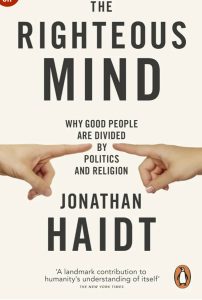
In an age of shouting matches masquerading as debate, the American social psychologist Jonathan Haidt offers an uncomfortable diagnosis: we are not, most of the time, thinking creatures who occasionally feel strongly. We are feeling creatures who occasionally think. In his influential 2012 book The Righteous Mind: Why Good People Are Divided by Politics and Religion, Haidt argues that moral and political conviction is driven far more by intuition than by reason — and that understanding this is the only way to make sense of why ordinary, decent people end up holding, and defending, extreme views.
The rider and the elephant: Haidt’s central image is a person riding an elephant. The rider represents conscious, verbal reasoning — the part of us that constructs arguments, cites evidence, and explains our positions. The elephant represents the much larger, older system of intuition and emotion. The rider likes to imagine he is in charge, steering the elephant wherever logic points. In reality, Haidt suggests, the relationship runs the other way: the elephant leans toward a judgment in a split second, and the rider’s job is mostly to invent justifications after the fact.
This is not a flattering picture of human rationality, but it is, Haidt argues, a more accurate one. Decades of research in moral psychology have shown that people often reach a moral verdict — this is wrong, that is unjust — almost instantly, and only afterward search for reasons to support it. Reasoning, in this model, functions less like a judge weighing evidence and more like a lawyer building a case for a client whose guilt or innocence was decided in advance.
Six taste buds of morality: The second pillar of Haidt’s argument is what he calls moral foundations theory. Just as the tongue has taste receptors for sweet, salty, bitter and so on, Haidt proposes that human moral judgment rests on a small number of evolved foundations: care versus harm, fairness versus cheating, loyalty versus betrayal, authority versus subversion, sanctity versus degradation, and liberty versus oppression. Individuals and political cultures differ not because one side has morals and the other doesn’t, but because they weight these foundations differently. Haidt’s research suggested that people on the political left tend to rely heavily on care and fairness, while conservatives draw more evenly on all six — including loyalty, authority and sanctity, foundations that liberals often view with suspicion or treat as vestiges of tribalism.
This is one of the book’s more provocative claims: that ideological opponents are not usually stupid or evil, but are, in effect, speaking different moral languages, each internally coherent, each rooted in a genuine ethical intuition — even when the practical conclusions clash violently.
Groupish, not selfish: The third strand of Haidt’s argument concerns why moral conviction so easily hardens into tribal loyalty. He describes human beings as “90 percent chimp and 10 percent bee” — overwhelmingly self-interested like other primates, but capable, in certain moments, of a hive-like capacity to submerge the self into a group and act for its glory. Sports crowds, religious congregations, protest marches and political rallies can all trigger this “hive switch,” Haidt suggests, producing an intense, almost euphoric sense of belonging that has nothing to do with the actual policy argument at hand.
It is here that readers often reach for a neuroscience shorthand — the idea of a “dopamine kick” driving extreme belief. Haidt’s own book does not frame things in these precise pharmacological terms; his argument is psychological and evolutionary rather than a claim about brain chemistry. But the underlying intuition lines up with what neuroscientists have separately found: that social belonging, moral outrage and the sense of righteous certainty activate the brain’s reward circuitry much as other pleasurable experiences do. Being part of a righteous “us” against a wicked “them” does not just feel morally correct — it feels good, in a fairly literal, physiological sense. Extremity, on this reading, is not a bug in human psychology but almost a feature: the more absolute the conviction and the more embattled the group feels, the more intense the accompanying rush of belonging and self-righteousness can become.
Why this matters for India today: Haidt’s framework travels well beyond American culture wars. It offers a lens for understanding why debates in India — over religion, caste, language, nationalism or reservation policy — so often generate more heat than light. If moral judgments are intuitive first and rational second, then presenting an opponent with facts rarely changes their mind, because the facts are being fed to a rider who was never driving in the first place. Real persuasion, Haidt argues, requires approaching the elephant, not just the rider: building trust, finding shared moral ground, and showing respect for an opponent’s underlying values before expecting them to engage with an argument.
None of this means all views are equally valid, or that moral relativism is the answer. Haidt is explicit that his goal is not to end disagreement but to reduce the contempt that makes disagreement so toxic. Understanding that our certainty is manufactured largely below the level of conscious thought — and that it carries its own emotional rewards — is, in his view, the first step toward a public conversation less driven by tribal fury and more capable of genuine persuasion.
(Dr. Smita Pandey is prominent Delhi based historian)