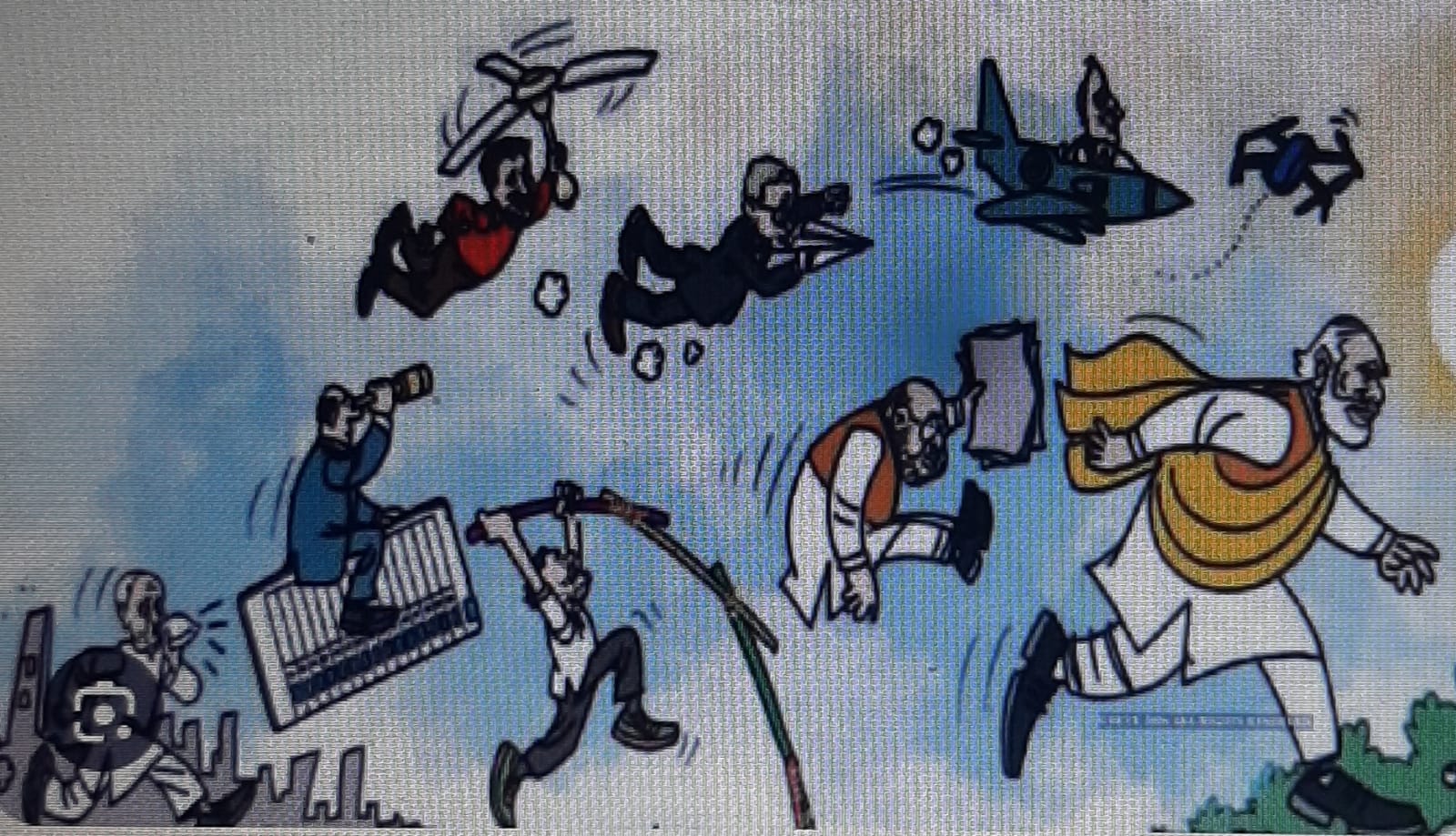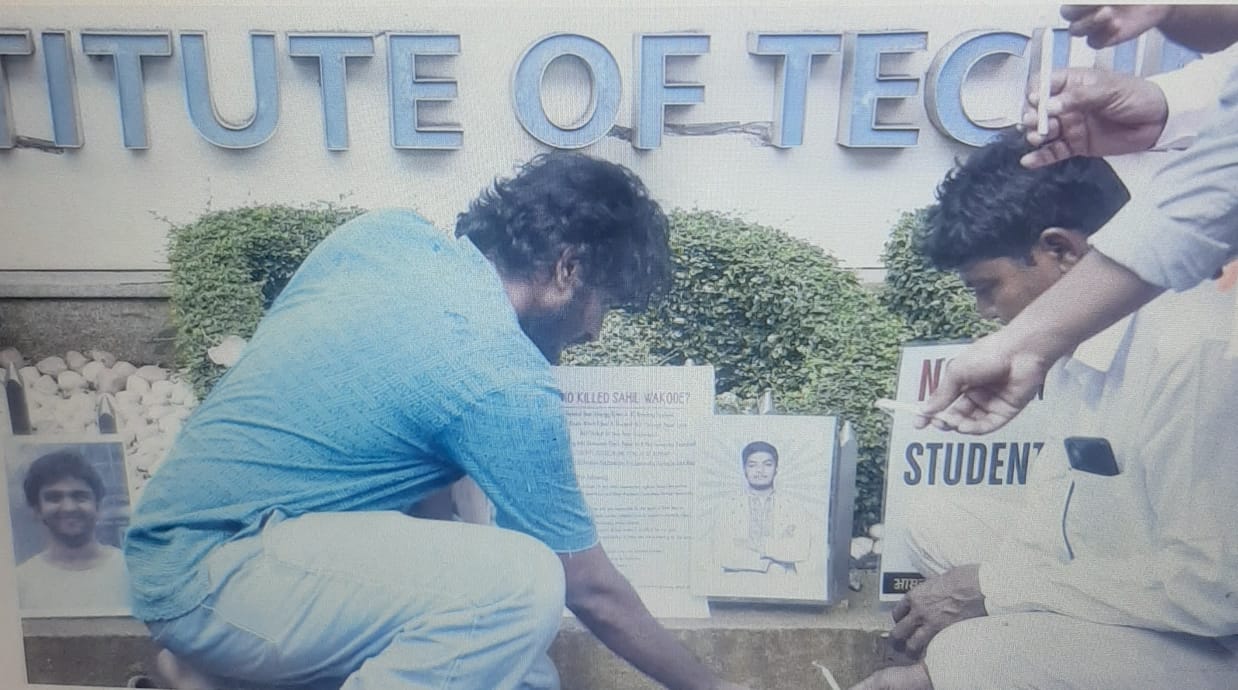


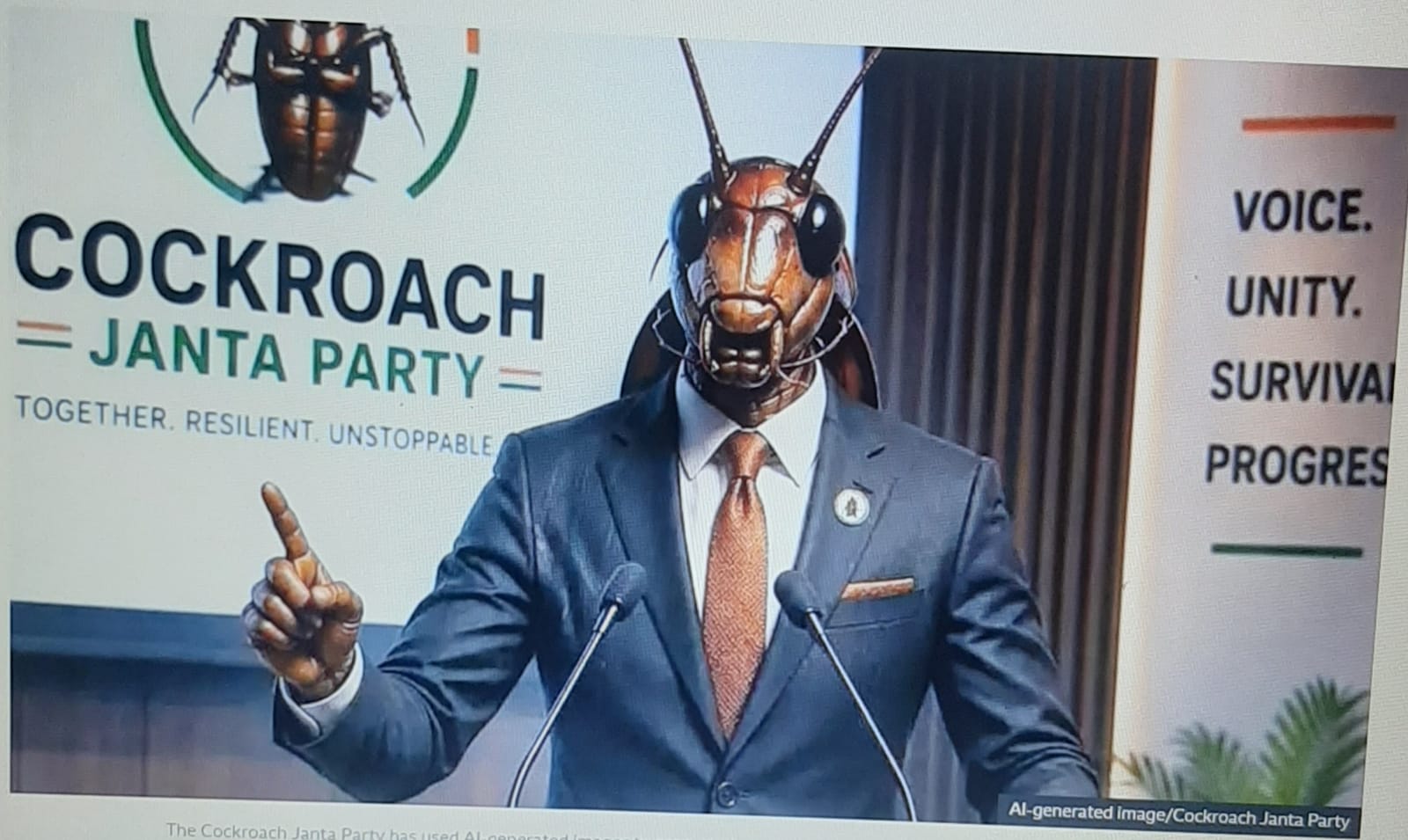
The Cockroach Janata Party is not a real political force. It will not file nominations or win seats. But it is a symptom. It tells us that a large number of Indians have stopped expecting anything from the system. They no longer believe that a vote changes anything. They no longer believe that a protest moves the needle. They see politicians as a separate species, one that feeds on public money and public patience and passes power to its children like a family heirloom. They see the police as protectors of the powerful. They see the courts as slow and expensive. They see bulldozers as the new judges. They see universities as empty shells. They see their own culture being shrunk into a narrow, angry version that does not recognise them. So they turn to irony. They call themselves cockroaches because that is how the system treats them. And by owning the insult, they take away the sting, writes Prof Syed Ali Nadeem Rezavi of Aligarh Muslim University.
The image is strange, even a little disgusting. A “Cockroach Janata Party.” On the surface, it sounds like a joke. But for millions of frustrated Indians, it feels painfully real. It is not a political party in any official sense. It is a cry made of dark humour, born from a nation that feels betrayed and dreams that have been shattered. Comparing a satirical cockroach to the French Revolution seems absurd. One is about guillotines and bloodshed. The other is a meme. Yet beneath the surface, the emotions are the same. When people lose faith in courts, leaders, and promises, they find a voice. Sometimes that voice is a revolution. Sometimes it is a cockroach.
To understand why this comparison works, we have to look at what happens before any uprising. People stop believing that the system will work for them. In France before 1789, the king and nobles lived in luxury while ordinary people starved. The government was corrupt and deaf to suffering. The common man had no real say. Something similar has happened in India over the last several years, not in one dramatic moment but through a slow, grinding disappointments that have touched every corner of the country.

Take the farmers’ protest of 2020-2021. For more than a year, thousands of farmers, mostly from Punjab, Haryana, and Uttar Pradesh, camped on the borders of Delhi. They were demanding the repeal of three farm laws that they believed would destroy their livelihoods. They were met with tear gas, water cannons, and barricades. The government called them anti national. The media called them puppets of foreign forces. But the people saw old men and women sitting in the cold, dying of heart attacks and suicides, just asking for a fair deal. The laws were eventually repealed, but the trust was not restored. Many farmers felt that the government only listened when the protest became too big to ignore. That feeling of being heard only under duress is a deep wound.
Then came the unemployment crisis. Every year, millions of young Indians graduate with degrees but no jobs. The government releases figures that do not match reality. The exam scams, the paper leaks, the recruitment delays. Young men and women spend years preparing for government jobs that never come. They sit in study circles, their dreams slowly turning into bitterness. When they raise their voices, they are told to be patient. Patient for what? For a system that seems designed to exhaust them?
But the dismantling of hope goes far beyond jobs. It has reached the very places where young minds are supposed to be built. India’s universities and colleges, once seen as temples of learning, are being systematically hollowed out. Budgets for education have been cut year after year. Faculty positions remain empty. Research grants have dried up. The flagship institutes like JNU, Jamia Millia Islamia, Aligarh Muslim University, and even the IITs and IIMs have seen political interference, surveillance of students and teachers, and the appointment of vice chancellors based on loyalty rather than scholarship. The new education policy talks about reform, but on the ground, libraries are closing, laboratory equipment is broken, and teachers are overworked and underpaid. A generation of young Indians is being pushed out of genuine learning and into coaching centres that teach only how to pass exams, not how to think.
The neglect of knowledge systems is even more tragic. India once had a rich tradition of pluralistic learning, where Sanskrit, Arabic, Persian, Tamil, and Bengali manuscripts sat side by side. But today, history textbooks are being rewritten to fit a narrow version of the past. Scholars who question the official narrative are intimidated, sued, or forced to leave their positions. The social sciences are seen as suspect. Philosophy, comparative religion, and even basic sociology are being removed from curricula. What is left is a hollow, job oriented education that produces workers, not thinkers. The idea of a university as a space for debate, dissent, and discovery has been replaced by the idea of a university as a training ground for obedient employees. When you kill real education, you kill the soul of a society. People stop asking why. They only learn how to survive. That is the goal. An unthinking population is easier to rule.
And who rules? Increasingly, the same families. One of the deepest betrayals of the Indian promise has been the way political positions have become hereditary property. Every major party, regardless of ideology, has turned into a family business. The sons, daughters, grandsons, daughters in law, and nephews of sitting politicians are given tickets for elections. They are made ministers, chief ministers, even prime ministers. Experience does not matter. Talent does not matter. Loyalty to the family matters. A young person from a poor family, no matter how brilliant or hardworking, will never get a chance to lead because the top positions are reserved for the progeny of one brand of politicians. This is not a republic. This is an oligarchy of bloodlines dressed in election clothes.
The common people watch this and feel a deep, cold anger. They see a young man who has never worked a day in his life become a member of parliament while their own son, with a master’s degree and five years of hard work, cannot even get a clerk’s job. They see a daughter in law of a powerful family become a minister while their own daughter, who topped the university, is told to wait for a vacancy that never comes. The system is not just corrupt. It is closed. The gates are locked from the inside. And the people outside are told to be grateful for the crumbs.
All of this has been accompanied by a slow, steady dismantling of an inclusive society and what many once understood as Indian culture. India was never a monolithic culture. It was a river with many tributaries. Hindus, Muslims, Sikhs, Christians, Jains, Buddhists, Parsis, Jews, Adivasis, Dalits, and countless castes and tribes all lived, often badly but together, in a messy but functional pluralism. The idea was not that everyone agreed, but that everyone could exist. That idea is being replaced. The new vision of Indian culture is narrower, louder, and more exclusive. It speaks one language primarily. It worships one set of gods. It celebrates one version of history. Everyone else is asked to either assimilate or leave. And if they cannot leave, they are told to be quiet.
This is not just about religion. It is about food, dress, music, and even the way people mourn their dead. Interfaith marriages are attacked by mobs and sometimes by families. Love is treated as a crime if it crosses the wrong line. Food stalls are forced to put up signs declaring their owners’ names and religions. Festival processions are deliberately routed through sensitive neighbourhoods to provoke a reaction. The very air in many towns has become tense. People do not speak freely anymore. They do not invite neighbours from other communities to their homes. They do not send their children to certain schools. They do not celebrate together. The old, comfortable, chaotic India is being replaced by a cleaner, colder, more suspicious place. And the people who are suffering the most are the ordinary ones who just want to live their lives without fear.
But the betrayal goes deeper still. It has entered the realm of safety and belonging. Across India, we have seen a rise in communal clashes and lynchings. Men have been killed for transporting cows, for eating beef, for merely looking different. In Rajasthan, a man named Pehlu Khan was beaten to death by a mob in broad daylight while his sons watched. The attackers walked free. In Jharkhand, a Muslim man named Alimuddin Ansari was killed for refusing to stop selling meat during a religious procession. In Karnataka, a man was lynched over a social media post. These are not isolated incidents. They are a pattern. And in each case, the state’s response has been either silence or slow justice. People have learned that if you belong to the wrong community, your life is cheap. The police are often absent or complicit. The courts take years. The government sometimes praises the mob. That is not a failure of law and order. That is a failure of the idea of equal citizenship.
Then there is the new kind of punishment that has emerged in recent years. It is called bulldozer justice. The name itself tells you what it is. No court order. No notice. No chance to defend yourself. Just a bulldozer that arrives one morning and flattens your home, your shop, your mosque, your madrasa. After communal violence in a town, the government does not wait for an investigation. It does not arrest the guilty through a fair process. Instead, it sends bulldozers to the homes of accused or even to the entire neighbourhood of a particular community. The message is clear. You are guilty until proven poor. Your house will be destroyed before any judge looks at your case.
There have been many such instances. In 2020, after a Hindu priest was killed in a suspicious encounter, riots broke out in parts of Delhi. The government responded by demolishing the shops and homes of Muslims in the affected areas. In 2022, after a man was beheaded in Udaipur by two Muslims who posted a video of the act, the government did not just arrest the killers. It bulldozed the home of one of the accused in Rajasthan. In Uttar Pradesh, towns like Khargone, Jahangirpuri, and Jalalabad have seen bulldozers roll in after every major clash, regardless of who started the violence. The victims are almost always from minority communities. And the bulldozer operators are cheered on by local politicians who post videos of the demolitions on social media to win applause from their supporters.
What makes bulldozer justice truly terrifying is that it bypasses every institution that is supposed to protect a citizen. The police can arrest you. The court can convict you. But even before that happens, the state can destroy everything you own. Your home is not just a roof. It is your savings, your memories, your address, your identity. When a bulldozer flattens it, you become a refugee in your own city. Your children cannot go to school because you no longer have an address. Your business is gone. Your neighbours are afraid to help you. And you cannot complain because the politicians who ordered the bulldozers are the same people who control the police and the courts. So you suffer in silence. You pack whatever you can carry. You move to a rented room in a slum. You do not tell anyone what happened because you are afraid. That is the goal of bulldozer justice. It is not just punishment. It is a public warning to everyone from your community. Step out of line, and we will erase you from the map.
Then there is the more technical but equally cruel weapon: the mass removal of names from voter lists. In states like Assam, Uttar Pradesh, and Gujarat, thousands of people, mostly Muslims and Dalits, have found their names missing from voter rolls just before elections. No notice. No hearing. They go to vote and discover they no longer exist. The excuse is usually a clean up of fake voters, but the people who are removed are real. They have lived in the same house for generations. They have ration cards, Aadhaar cards, land records. But the system quietly erases them. If you cannot vote, you do not matter. Your complaint goes nowhere. You become a ghost in your own country. This is a kind of institutional betrayal that does not make headlines but destroys faith one person at a time.
Assam itself is a deeper wound. The National Register of Citizens, or NRC, was meant to identify illegal immigrants. But the process was chaotic, rushed, and cruel. Nearly two million people were left out, many of them Bengali speaking Muslims. They were told to prove their lineage, to produce documents from before 1971. For poor villagers, for women who never went to school, for people whose homes had no electricity or land records, this was impossible. Families were separated. Fathers were sent to detention camps. Children grew up without parents. The promise was that genuine citizens would be protected. The reality was that entire communities were made to feel like foreigners in their own home. And even now, years later, thousands of people are still waiting in camps, their lives frozen, their citizenship uncertain. The government has stopped talking about the NRC, but the fear remains.
Manipur and the other states of the northeast tell a similar story. The conflict between the Meitei and Kuki communities has burned for months, with dozens killed and thousands displaced. Homes have been torched. Women have been paraded naked. The army has been called in, but peace has not returned. People in Manipur feel abandoned by Delhi. They feel that the rest of India does not care because Manipur is far away and its people look different. The internet has been shut down again and again, cutting them off from the world. When the world does not see your pain, it is easier for the state to ignore you. The people of Manipur have learned that their lives are not considered as important as the lives of people in the capital. That is a terrible lesson.
Bengal, too, has seen its share of blood. The 2021 elections were followed by waves of post poll violence. Houses were burned. People were killed. Women were assaulted. The ruling party and the opposition blamed each other, but the victims were ordinary people who had voted for the wrong side. The police did little. The courts moved slowly. Many families fled their villages and lived in relief camps for months. They went back to find their homes destroyed and their neighbours hostile. The message was clear: democracy is fine as long as you choose the winner. If you choose the loser, you pay with your blood. That is not democracy. That is a warning.
The Cockroach Janata Party speaks to all these people. The farmer who lost a son to police bullets. The young Muslim who fears walking at night because a mob might mistake him for a cow smuggler. The man who watched a bulldozer crush his home while a chief minister smiled on television. The Assamese woman whose father sits in a detention camp with no trial date. The Manipuri mother who fled her burning village and now lives under a plastic sheet. The Bengali man whose house was torched because he supported the wrong candidate. The young graduate who gave ten exams and failed each time by one mark, and then watched the son of a politician get a job without any exam at all. The student whose university library was shut down because the books were deemed too dangerous. The professor who lost his position because he asked an uncomfortable question. The Dalit whose name was removed from the voter list. The shopkeeper whose stall was flattened without a single court notice. The young woman who fell in love with someone from another religion and now lives in hiding. The old man who remembers when neighbours shared food during festivals and weeps at what the country has become. The cockroach is a survivor. It lives in filth, eats scraps, and refuses to die. For all these people, the cockroach is not an insult. It is an identity. It says, “You have pushed me into the gutter, but I am still here.”
This kind of protest is not new in India. We have seen it before. In 2011, Anna Hazare sat on a fast for the Jan Lokpal Bill, an anti corruption law. Millions of ordinary Indians came out to support him. They were tired of paying bribes for everything from a driver’s license to a hospital bed. The movement was peaceful, Gandhian in style. But the government dragged its feet. The bill was passed in a weak form. The energy fizzled out. People went back home, more cynical than before. They learned that even a respected activist and a mass movement could be managed, delayed, and finally forgotten.
Then there was the Nirbhaya case in 2012. A young woman was brutally gang raped on a moving bus in Delhi. She died days later. The entire country erupted in anger. People marched, held candles, and shouted for justice and safer cities. The government promised fast track courts, stricter laws, and safer streets. But years later, the situation for women has not changed much. Rapes continue. Convictions remain low. The promised change never arrived. The protestors felt used. Their anger was briefly acknowledged and then absorbed. That is a terrible feeling. When your pain becomes a headline for a week and then disappears.
The French Revolution was different in scale and violence, but the emotional journey was the same. People first asked politely. Then they begged. Then they protested. Then they rioted. Then they smashed everything. The Cockroach Janata Party is not at the smashing stage. It is at the stage of bitter laughter. But that laughter is a warning. History shows that when people lose faith in peaceful protest, they either give up or explode.
There was another moment in recent Indian history that captures this loss of faith. The 2019 protests against the Citizenship Amendment Act, or CAA, and the National Register of Citizens, or NRC. Thousands of students, particularly from Jamia Millia Islamia and Aligarh Muslim University, were beaten by police inside their own campuses. The internet was shut down. Leaders were put under house arrest. Yet people poured into the streets, especially women in Shaheen Bagh. They sat for months, knitting and singing, refusing to move. The government called them anti national and traitors. The protestors were not asking for much. They just wanted the government to not turn its back on Muslims seeking refuge. But the message from the government was clear: dissent would be crushed. Many people quietly went home, not because they agreed, but because they were exhausted and afraid. That exhaustion is the perfect breeding ground for satire. When you cannot shout, you laugh. When you cannot hold a rally, you share a meme.
The Cockroach Janata Party is not a real political force. It will not file nominations or win seats. But it is a symptom. It tells us that a large number of Indians have stopped expecting anything from the system. They no longer believe that a vote changes anything. They no longer believe that a protest moves the needle. They see politicians as a separate species, one that feeds on public money and public patience and passes power to its children like a family heirloom. They see the police as protectors of the powerful. They see the courts as slow and expensive. They see bulldozers as the new judges. They see universities as empty shells. They see their own culture being shrunk into a narrow, angry version that does not recognise them. So they turn to irony. They call themselves cockroaches because that is how the system treats them. And by owning the insult, they take away the sting.
The French Revolution ended with Napoleon, a dictator. The Indian farmer protests ended with a repeal, but no justice for the dead. The Anna movement ended with a weak law. The Nirbhaya movement ended with the same fear on the streets. The CAA protests ended with silence and surveillance. The Assam NRC process ended with thousands still waiting in camps. The Manipur violence ended with no real accountability. The Bengal post poll violence ended with the same families still afraid. And the bulldozers have not stopped. They keep rolling. Every few months, some town erupts, some home is flattened, some family becomes homeless overnight. The people watch in silence because they know that speaking up might bring a bulldozer to their own door. That silence is not peace. That silence is the sound of a nation holding its breath.
And underneath that silence, something else is growing. Not a party. Not a leader. Not a manifesto. Just a shared feeling, passed through memes and whispers and bitter jokes. The feeling that the India of the promise, the India of the constitution, the India where everyone had a place, is gone. What is left is a colder, meaner place, where your worth is determined by your bloodline, your religion, and your willingness to stay quiet. The Cockroach Janata Party is not the answer to this. It is just the name of the wound.
So what comes next? Maybe nothing. Maybe the cockroach just keeps crawling. But maybe, one day, enough people get tired of laughing and tired of suffering in silence. They remember that a cockroach, when stepped on, does not always die. Sometimes it multiplies. That is the real lesson from history. Betrayal is a slow poison. But when it reaches a certain level, even a cockroach can become a revolution. The only question is whether the people of India will continue to bow their heads or finally decide to bite back.