

As India chases a $2 trillion export target, its exporters drown in paperwork, bribery demands, and refund delays that can cripple a small business before its goods reach the ship. The fix exists — three Asian neighbours have already done it, writes former IAS officer V.S.Pandey
Late last October, a Chennai importer took to social media with a claim that would have surprised nobody in India’s trading community — and alarmed everyone else. A customs official, he alleged, had demanded a bribe of ₹2.1 lakh to release a shipment worth less than $7,000. The company announced it would shut down all India operations, citing forty-five days of what it called “unjustified harassment.” Chennai Customs denied the allegations as usual and the complaint put in the dust bin. The shipment — eventually — moved. The story, however, did not end there. It never does.
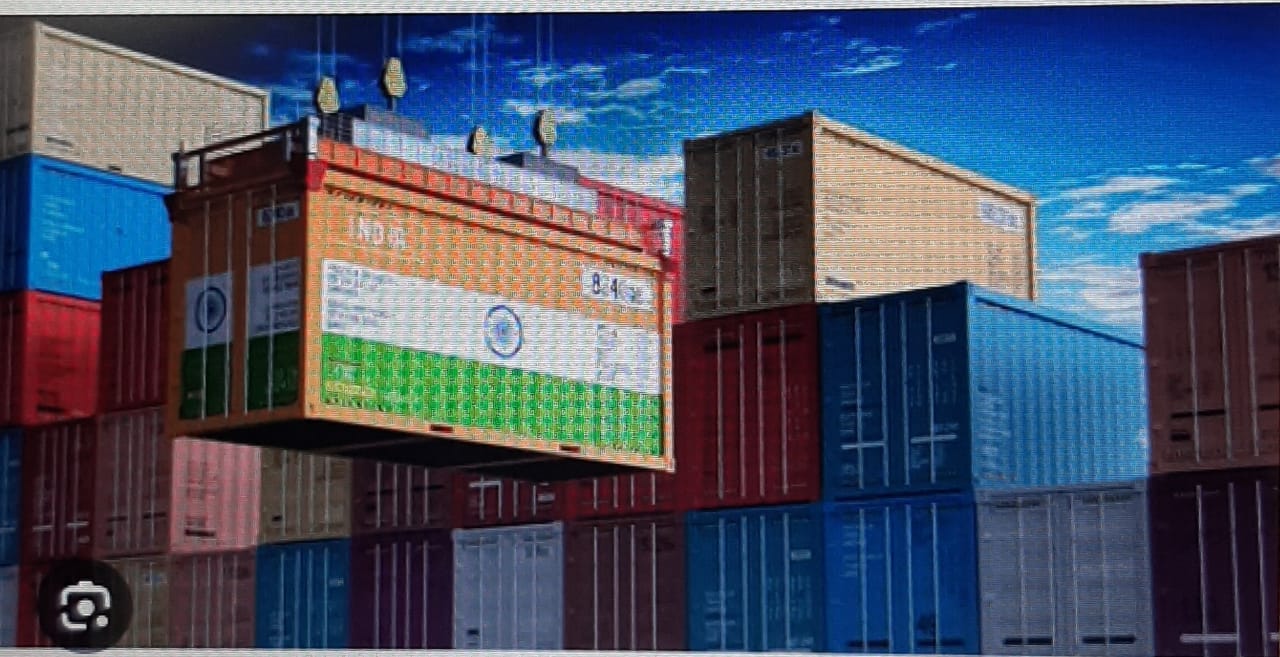
That episode is a single data point in a structural crisis. India is the world’s fifth-largest economy and aspires, by government declaration, to reach $2 trillion in annual exports by 2030. Yet the machinery through which goods physically leave this country — the documentation, the clearances, the refunds, the port procedures — remains among the most corrupt and cumbersome on earth , with every babu and officer siting like a crocodile to gobble up as much as possible. Indian exporters spend roughly 60 to 100 hours completing documentary compliance alone for a typical shipment. Singapore does the same in under four hours. South Korea does it in two. Japan, using pre-arrival electronic declarations, can clear a shipment in four hours from the moment a vessel docks.
“Indian exporters spend 60–100 hours on documentary compliance. Singapore does the same in under 4 hours.”
WORLD BANK TRADE FACILITATION DATA
The gap is not a mystery. It is a policy choice — or more precisely, a series of policy failures, compounded over decades, that was in the knowledge of everyone from top to bottom but the problem have never been confronted as a whole. Understanding them requires looking at the system from the exporter’s vantage point, not the regulator’s.
The Many Gates an Exporter Must Pass
To export a consignment from India, a business must navigate the Directorate General of Foreign Trade for its Importer-Exporter Code and trade policy compliance; the Central Board of Indirect taxes and Customs(CBIC) , Indian Customs Electronic gateway (ICEGATE) portal for customs and the Shipping Bill; the GST portal for return filings and the Letter of Undertaking that permits zero-rated export; the Reserve Bank of India’s Export Data Processing and Monitoring System for foreign exchange reporting; port authorities for terminal handling and berth allocation; and a constellation of product-specific regulators — FSSAI for food, the Drug Controller for pharmaceuticals, BIS for standards-regulated goods, APEDA for agricultural products, and so on. Each of these agencies runs a separate system, speaks a separate language, and operates on a separate timeline. None of them automatically talks to the others. India’s Single Window Interface for Facilitating Trade, known as SWIFT, was designed to change this but has in practice become an aggregator of links to those same silos rather than a genuine unified platform. One submission does not satisfy all authorities. The exporter must still chase each desk individually. And at each desk, discretion resides with an officer.
That discretion is the engine of corruption. When an official can hold a shipment by questioning its classification, querying its valuation, or simply not processing a file, the rational response for an exporter racing a buyer’s deadline is to pay. The bribery is not aberrational — it is a rational market response to a system that makes delay the default.
The GST Refund Trap
For the forty percent of India’s exports that come from micro, small, and medium enterprises, the most lethal bottleneck , in addition to the customs officer — it is the GST refund. Exports are zero-rated under GST, meaning exporters pay input taxes during production and are entitled to refunds after shipment. But those refunds take weeks, sometimes months, to arrive. The RBI itself has documented the consequence: MSME exporters depend on daily cash flows for working capital. Without the refund, they cannot buy the next batch of inputs. Without inputs, they cannot fulfil the next order. Without the next order, the business contracts. An exporter caught in this cycle described it, in a federation survey, as a “hand-to-mouth existence.” As recently as late 2025, the government was still sitting on roughly ₹800 crore in pending dues to exporters under the Interest Equalisation Scheme — a scheme it had simultaneously allowed to lapse without renewal.
EXPORT CLEARANCE: INDIA VS. THE WORLD-
Singapore 2–4 hrsTradeNet single window, fully automated
South Korea 2 hrsUNI-PASS pre-clearance, 2 min for exports
Japan4 hrsNACCS: e-manifest 72 hrs pre-arrival
Netherlands~2 hrsPortbase community system at Rotterdam
India60–100 hrsMulti-agency, manual, high discretion
Layered atop this is infrastructure — or its absence. Landlocked states such as Uttar Pradesh, MP, Uttarakhand ,Bihar and Jharkhand etc. face transit times to gateway ports that are three times longer than in comparable competing nations. Cold chain infrastructure for agricultural exports, one of India’s fastest-growing categories, remains woefully inadequate. And frequent, abrupt policy reversals — sudden bans on wheat exports, restrictions on rice and onions, often without notice — have made global buyers hesitant to rely on India as a dependable supplier. Reliability, in international trade, is a currency. India keeps spending it.
What Singapore Did — And India Should Copy
Singapore built the world’s first electronic single window for trade in 1989 — with computing power a fraction of what India possesses today. Its TradeNet system processes over 30,000 customs declarations daily, each accompanied by automatic payment of applicable duties. Users report cost savings of up to thirty percent simply from simplified documentation. The philosophy embedded in the system is explicit: Singapore Customs sees itself as the trade highway police, whose job is to facilitate smooth movement for law-abiding traders — not to slow them down or penalise them.
South Korea took a different path to the same destination. Its uTradeHub, built through a public-private partnership bringing together government ministries, the Korea Customs Service, and private trade bodies, created a national paperless platform. The result: customs clearance at Incheon Port now averages two hours. For exports, the single window achieved two-minute clearance. Japan’s NACCS system requires exporters to file electronic manifests 72 hours before a vessel arrives, so by the time the ship docks, Tokyo Customs has already assessed the risk, assigned the channel, and prepared the release. Average clearance: four hours. The Netherlands built Portbase at Rotterdam as a fully logged, time-stamped community platform where no official can hold a shipment without the delay appearing instantly in a system-wide audit trail. Discretion, effectively, has been designed out.
All four of these systems share three features: a single submission that satisfies all agencies simultaneously; risk-based inspection that automatically routes trusted exporters through a green channel without physical examination; and full auditability that eliminates the space in which corruption lives.
A Blueprint India Can Execute
India is not without assets. The Goods and Services Tax Network, the ICEGATE portal, and the Unified Payments Interface demonstrate that this country can build large-scale, real-time digital infrastructure at national scale. The GSTN alone handles hundreds of millions of transactions. The problem is not capability — it is integration and will.
A serious reform programme would do five things. First, transform SWIFT into a genuine single window where one data submission — filed once — simultaneously satisfies Customs, DGFT, GST, RBI, and all sector regulators, on the Singapore model. Second, implement pre-arrival processing on the Japanese model, so that all documentary assessment completes before goods reach the port. Third, deploy a proper risk-scoring engine that routes eighty to eighty-five percent of shipments through an automatic green channel, reserving human inspection for genuinely flagged consignments and dramatically cutting officer discretion. Fourth, automate GST refunds through real-time reconciliation between GSTR-1 and shipping bills, so that verified exporters receive refunds within seven days, not months. Fifth, adopt full digital auditability across all export touchpoints — every delay beyond a defined SLA should automatically escalate and be permanently logged.
None of this is technically difficult. South Korea built its system in a decade. Mauritius, after introducing a single window, cut average clearance time from four hours to fifteen minutes. The Democratic Republic of Congo reduced export documentary time by 122 hours by implementing a basic single window with proper training. India’s challenge is not the software. It is the political economy of an officialdom that has, for decades, derived power and illicit income running into thousands of crores of rupees from the opacity that delays create.
The $2 trillion export target is achievable. But it will not be achieved by exporters heroically persisting against a system designed to frustrate them. It will require dismantling that system — desk by desk, gate by gate — and replacing it with one that regards every exporter, until proven otherwise, as a partner rather than a suspect. Singapore figured this out in the 1980s. India, in 2026, is still waiting.
(Vijay Shankar Pandey is former Secretary Government of India)